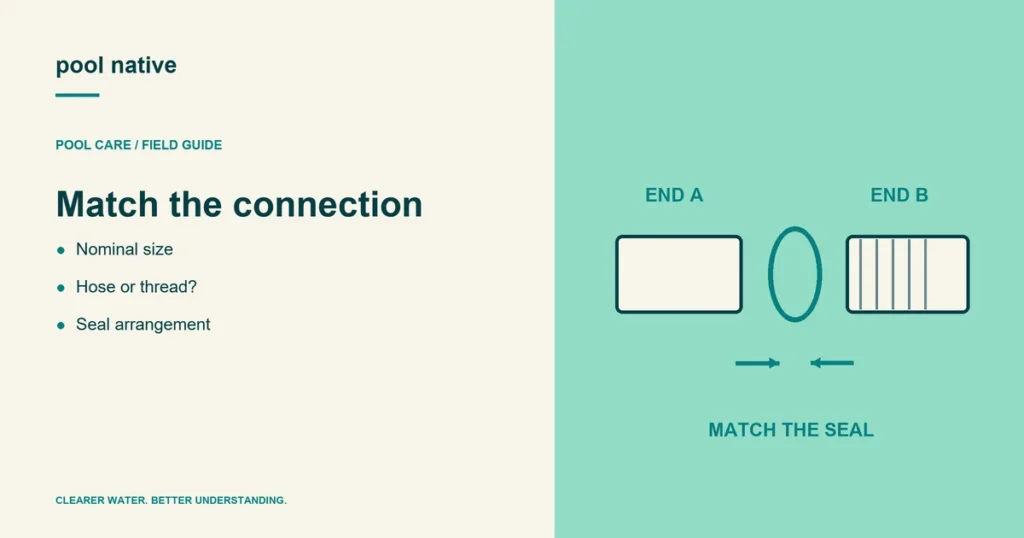
Pool filter hose sizes describe the water passage, but the connection also has to match. Measure the hose bore separately from the collar, then identify how the joint seals and stays attached. A large threaded nut does not necessarily mean a large hose diameter.
Before removing a hose, shut down and isolate the equipment using its instructions. Control water escaping from the pool with the approved valves or plugs. Never dismantle a pressurized or operating connection to take a measurement.
Separate the hose from the fitting around it
A corrugated hose, its cuff, and its retaining collar can all have different outside dimensions. Photograph them together before disassembly. Note where the washer or seal sits rather than assuming the threads make the watertight seal.
Intex identifies common hose bores as 32 mm and 38 mm. Its guidance also lists larger external fitting dimensions for a 38 mm hose. This explains why a ruler across the nut can send you toward the wrong replacement.
In US listings, those common hose categories are often called 1.25 and 1.5 inches. Treat them as nominal product categories and verify the matching part. Do not convert a measurement into a thread standard without supporting specifications.
Identify how each joint works
| Connection style | What to record | Common mistake |
|---|---|---|
| Hose over a spigot with a clamp | Hose bore, spigot shape, insertion depth, and specified clamp. | Measuring only the outside of the hose. |
| Hose with a threaded retaining collar | Collar identity, mating fitting, and the gasket or seal arrangement. | Assuming every similar thread is compatible. |
| Adapter between two connection styles | Both ends, flow direction where relevant, and exact adapter part number. | Buying an adapter that converts in the opposite direction. |
A connection that starts to screw together has not passed a compatibility test. Cross threading may begin easily before the collar binds. Stop if parts resist, sit crooked, or fail to reach the intended sealing position.
Do not add tape, glue, or extra washers to make an unidentified joint work. Follow the fitting’s intended sealing method. A missing gasket requires the correct gasket rather than more force on the nut.
Record pool filter hose sizes at both ends
Make one record for the pool to pump route and another for the return route. Include each intermediate valve, tee, heater, or chlorinator. The same looking hose may terminate in different fittings along those paths.
Pool model and year or product code, plus the marked connection position.
Pump and filter model numbers, with the connection part numbers from their diagrams.
Hose bore and length, plus photographs of the cuff, collar, gasket, and mating surface.
Whether a clamp, threaded collar, or documented adapter secures each end.
Label the direction in words: water to pump or water returning to pool. Port letters are useful only with the matching model diagram. Preserve any dual suction arrangement instead of reducing the number of connections.
Use an adapter description narrowly
Intex Adapter B 29061E is described for converting specified Intex clamp fittings to larger screw fittings. That description is useful evidence for its stated application. It does not prove compatibility with every fitting sold under another brand.
For a mixed setup, use the cross brand connection checklist. Send your endpoint record to the supplier if the exact pairing remains unclear. A seller’s broad list of brand names is weaker evidence than identified mating parts.
Choose the replacement for service as well as fit
Use hose intended for the documented pool filtration application. Match length without creating sharp bends or pulling sideways on the pool wall fitting. Leave the access required to operate valves and service the equipment.
Once installed according to the manual, check joints with circulation stopped and during normal operation. Investigate leaks at their actual source. If you are changing pump size too, review the whole upgrade plan before treating a fitting match as approval.