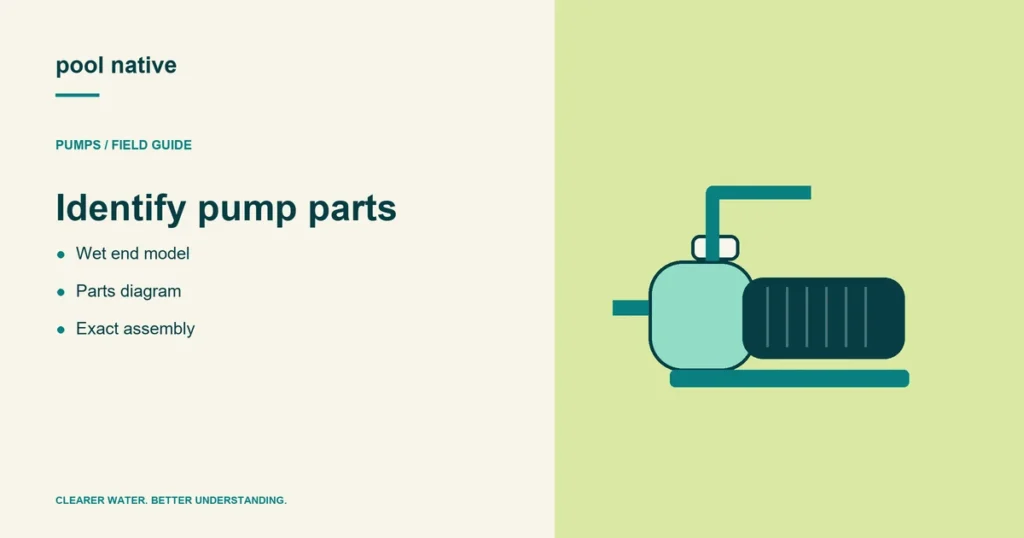
Pool pump parts identification starts with two labels: the complete pump model and, where separate, the motor label. The pump includes the water handling components as well as its motor. On electronic models, the drive or controller adds another distinct assembly.
Identify the part by location and function before shopping. A “pump seal” can mean several different components.
Pool pump parts identification by function
| Part | Job | What to record |
|---|---|---|
| Strainer basket | Catches debris before it reaches the impeller | Basket part number and seating shape |
| Lid and lid ring | Provide access and seal the strainer pot | Lid mechanism and exact ring |
| Wet end or housing | Contains the water path and hydraulic parts | Complete pump model and assembly revision |
| Impeller and diffuser | Move and direct water inside the pump | Model specific parts and motor compatibility |
| Shaft seal | Seals around the rotating shaft arrangement | Specified mechanical seal kit |
| Motor and drive | Provide rotation and, where fitted, electronic control | Both identification labels and control system |
| Unions and drain plugs | Connect plumbing and allow specified draining | Connection type, seals, and part numbers |

The basket and lid are service parts, not universal shapes
A basket must seat correctly and stay intact. A similar basket that floats, tilts, or leaves a bypass gap isn’t an acceptable substitute. Use the basket care guide for normal handling.
Lids may use different threaded, cam, or locking arrangements. Identify the mechanism before applying a removal tool. If it will not open normally, follow the stuck lid route.
Distinguish the seals
A lid ring seals the access cover; a housing seal joins stationary sections; a shaft seal serves the rotating assembly. Union and drain plug seals have their own jobs. Matching only the diameter can miss material or shape requirements.
The lid ring guide covers that specific replacement. Water underneath the motor belongs in the external leak diagnosis. Don’t apply lid lubricant as a general leak repair.
Use the exploded diagram correctly
Find the manual for the complete pump model and revision. A numbered callout points to a parts table; the callout number isn’t necessarily the orderable part number. Check quantity and what each kit includes.
Record any serial or production information required by the catalog. Similar models can use different impellers, drives, or housings. Obtain confirmation before using a superseded part number.
Don’t disassemble a working pump just to identify an internal part. External labels and the correct diagram usually provide the starting information. Internal and electrical work should follow qualified service requirements.
Find the orderable part from the diagram
In Pentair’s cited SuperFlo DOE manual, diagram item 13 is the strainer basket; its part number is 355667. Item 15 is lid 350091, while item 16 is locking ring 350090. Ordering “part 13” without the manual reference loses the information a supplier needs.
This example applies to that manual revision, not every pump named SuperFlo. Confirm the complete model before treating any of those numbers as a match. A replacement motor label alone cannot identify the basket or lid.
For a suspected rotating shaft seal leak, use shaft seal leak diagnosis and service planning. For the separate diffuser, follow diffuser identification and damage checks. Identify the fault before buying an entire parts kit.
Build a useful equipment record
Save a label photo, manual, confirmed parts, and the symptom that prompted each repair. Keep the motor information separate from the pump model. That record makes future ordering more reliable than a photo of a similar product online.