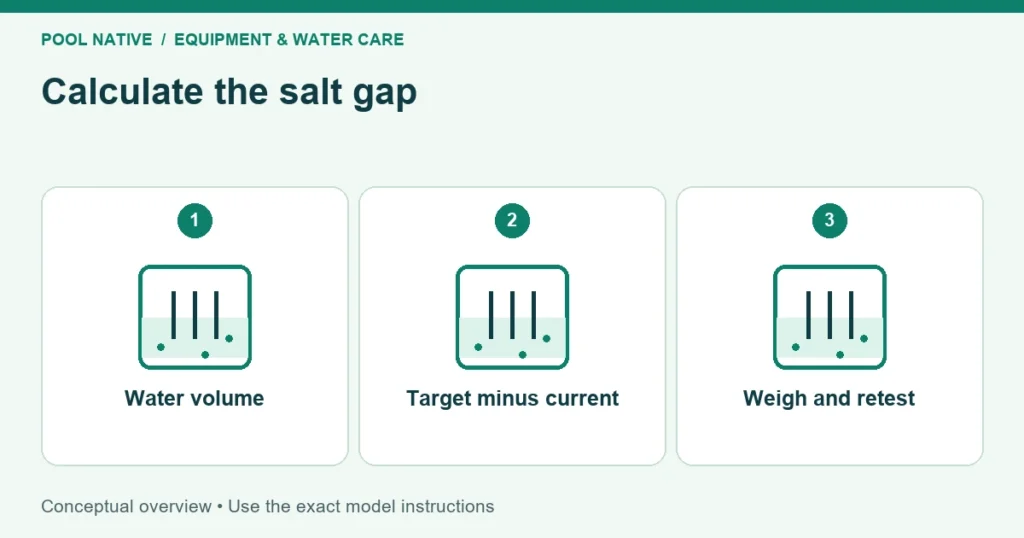
Use this pool salt calculator to estimate how much salt will raise your water from its measured salinity to your generator’s target. Enter the water volume and a recent independent salt test. Check the target in the manual for your exact system.
The result is an addition estimate, not permission to empty every suggested bag at once. Uncertain pool volume and salt testing can create a larger error than the calculation itself. Add conservatively, circulate, and retest before finishing the adjustment.
Choose the right inputs
Pool volume
Use the amount of water actually in the pool, in US gallons or liters. A pool’s advertised maximum capacity may differ from its normal operating volume. Builder records are useful when they reflect the finished shape and usual water level.
For an irregular pool, include changes in depth, benches, steps, and attached water bodies only when they share the treated water. Don’t use the outside dimensions of a framed pool as though they were the water dimensions. If volume remains uncertain, treat the first addition as a measured trial.
Current salt
Test before adding salt, even when converting an ordinary chlorine pool. Previous chemical use and the fill water can contribute dissolved salts. Entering zero without testing can overstate the amount needed.
Use a representative sample after the water has mixed. Don’t sample beside a dissolving salt pile or immediately at a return. See salt test accuracy if the strip, meter, and controller disagree.
Target salt
Use your generator’s specified target, not the highest value its display can tolerate. Different systems use different operating ranges. A target suitable for one model can be excessive for another.
For example, the classic Hayward AquaRite manual specifies an optimum of 3,200 ppm. Current Pentair IntelliChlor Plus and LT information specifies 3,600 ppm. These examples identify model families; they don’t override your own manual or an applicable regional version.
Purity and bag size
Salt purity adjusts the estimated product weight. A 99% pure product contains slightly less sodium chloride per pound than a theoretical 100% product. Enter the stated purity only for a salt product the generator manufacturer accepts.
The bag calculation converts weight into a shopping quantity. It doesn’t approve additives or make unsuitable salt acceptable. Use the guide to pool salt types when choosing a product.
How the salt calculation works
For typical pool calculations, one ppm is approximately one milligram of salt per liter of water. The calculator multiplies pool volume by the difference between target and current salinity. It then converts that salt mass into pounds and kilograms.
Kilograms of pure salt = liters × required ppm increase ÷ 1,000,000.
Pounds of pure salt = US gallons × required ppm increase × 0.0000083454.
If product purity is below 100%, divide the pure salt amount by purity expressed as a decimal. For 99% salt, divide by 0.99. This is an ordinary pool dosing approximation; water density and the small volume change from dissolving salt are not modeled.
Worked example: topping up an existing salt pool
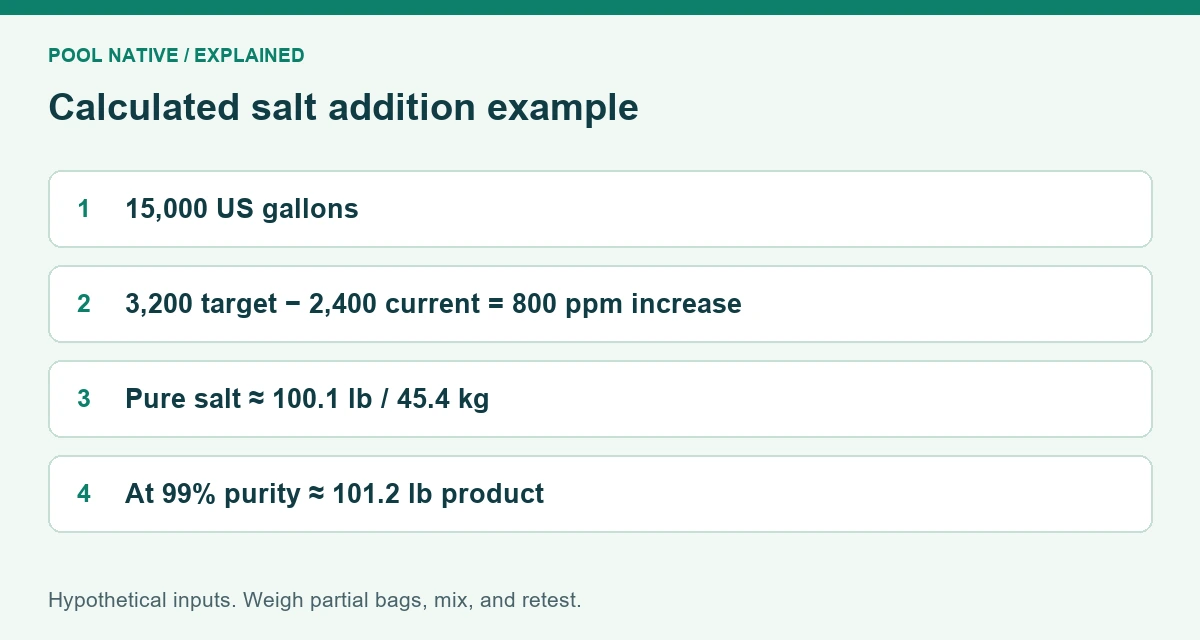
Suppose a hypothetical 15,000 gallon pool tests at 2,400 ppm and needs a target of 3,200 ppm. The required increase is 800 ppm. The estimated pure salt addition is approximately 100.1 pounds, or 45.4 kilograms.
With 99% purity, the product amount becomes about 101.2 pounds. That is approximately 2.53 bags weighing 40 pounds each. Buying three bags leaves some salt unused after the final measured adjustment.
Don’t round 2.53 bags up to three as the dose. The extra salt would remain in the water. Measure partial bags by weight rather than guessing from the height of salt left in the package.
Worked example: a new salt conversion
Consider a hypothetical 20,000 gallon pool starting at 500 ppm with a 3,200 ppm target. The 2,700 ppm increase requires about 450.7 pounds of pure salt. At 99% purity, that becomes about 455.2 pounds of product.
If you incorrectly entered zero as the starting salt, the estimate would increase by about 83.5 pounds of pure salt. That is more than two 40 pound bags. Testing the starting water matters much more than chasing extra decimal places in the result.
Use saltwater conversion planning before adding a large initial dose. Pool materials, new surface curing, and the existing sanitizer must be suitable first. Salt addition should follow the installation plan rather than precede those checks.
Add the estimate in stages
Keep chlorine generation off while adding and mixing salt, following the manufacturer’s instructions. The circulation pump can run as directed to distribute it. Brush settled salt so concentrated piles don’t remain on the surface.
Record the weight actually added and allow the prescribed mixing interval. Some generator instructions call for 24 hours before checking and restarting. A controller’s average reading can also take time to reflect the new concentration.
Retest independently after mixing, then calculate any remaining addition from that new measurement. Don’t calculate the full original dose a second time. Keep appropriate chlorine in the pool while the generator is disabled.
If the measured rise differs from the prediction, investigate before adding more. Check the test procedure, pool volume, recent water replacement, and whether all salt dissolved. A disagreement is useful evidence, not a reason to force the controller display toward the target.
When the calculator says no salt is needed
If current salinity equals the target, no addition is needed. If it exceeds the target, adding salt cannot help. The calculator reports zero addition and directs you to high salt correction.
That doesn’t automatically mean the pool must be drained. First confirm the concentration against the actual allowed range and an independent test. A false high reading or an unnecessarily low chosen target can create an avoidable water replacement project.
Removing dissolved salt usually requires a suitable water exchange or a specialist treatment that actually removes salts. Ordinary filtration and waiting for evaporation do not remove it. Structural limits and local discharge rules matter before any exchange.
Why a precise result still needs judgment
A ten percent volume error causes roughly a ten percent dosing error. A 200 ppm uncertainty in a small top up can be just as significant. Reporting 101.17 pounds does not make uncertain inputs accurate to a hundredth of a pound.
Use the calculator to establish a sensible quantity, then let mixed water tests guide the final adjustment. Save your volume estimate, bag weight, and before and after readings. Those records make the next top up easier and help identify a mistaken volume estimate.
You don’t need a fixed weekly salt dose. Salt leaves mainly when salty water leaves, while evaporation leaves it behind. Test when indicated by water replacement or system operation, and use saltwater pool maintenance to keep that task in context.


