
If your pool’s salt level is too high, confirm it with an independent test before replacing water. Compare the result with the operating range for your exact generator. A high controller reading can also come from an incorrect cell setting or equipment fault.
For genuinely excessive dissolved salt, a planned water exchange with lower salinity water is the usual correction. Ordinary pool filtration doesn’t remove dissolved salt. Evaporation leaves it behind, so waiting for the water level to fall is not a dilution method.
Decide whether correction is actually needed
Check the manual’s target and allowed range. Being above a preferred midpoint isn’t always the same as exceeding the permitted concentration. Don’t drain a pool just to make every test match a round number.
Repeat a questionable result after the water has mixed. Confirm units and use a suitable method, especially if a large salt addition was recent. Our salt testing guide explains how to compare a meter, titration, and generator reading.
If the water tests within range but the generator shows high salt, investigate its configuration and sensing. The same principles in salt reading disagreement apply. Water replacement cannot fix the wrong programmed cell model.
Test the replacement water too
Dilution works because the replacement water contains less salt than the pool. It may not contain zero salt. Well water or another local source can materially change the required exchange.
Test the source using a method suitable for its expected concentration. Some pool salt tests have a lower measurement limit, so a reading below that limit isn’t an exact zero. Use a suitable laboratory or meter result when source salinity could affect a large project.
Also consider the replacement water’s calcium, alkalinity, and other relevant properties. Correcting salt can change the rest of the pool chemistry. Plan the followup testing before the exchange begins.
Calculate one drain and refill exchange
For a well mixed pool, the approximate fraction to replace is:
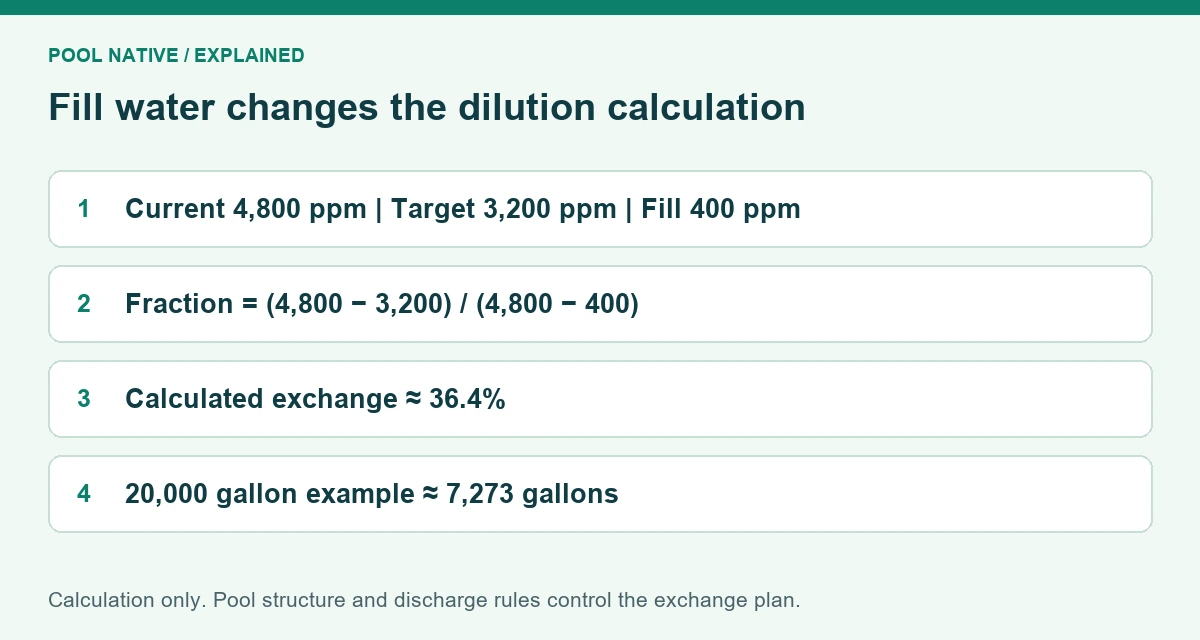
Fraction = (current salt − target salt) ÷ (current salt − replacement water salt).
All three salinity numbers must use the same units. Multiply the fraction by 100 for the percentage, or by pool volume for the amount of water. This model assumes one removal followed by refill to the original volume, with no simultaneous mixing during removal.
It also assumes the replacement water is below the target. If the replacement water equals or exceeds the target, the calculation can’t achieve that target by ordinary dilution. You need a different water source or a suitable specialist solution.
Worked example with salty fill water
Suppose a hypothetical 20,000 gallon pool is at 4,800 ppm and needs to reach 3,200 ppm. Its replacement water measures 400 ppm. The fraction is 1,600 divided by 4,400, or about 0.364.
That is approximately 36.4% of the water, or 7,273 gallons. It is a calculation, not an instruction to drain that amount in one operation. The pool’s structural limits may require another approach.
If you incorrectly assumed zero salt in the replacement water, the estimate would be only 33.3%. That smaller exchange would leave the pool around 3,333 ppm with 400 ppm fill water. Whether that is acceptable depends on the actual operating range.
| Example input | Value |
|---|---|
| Starting pool salinity | 4,800 ppm |
| Desired salinity | 3,200 ppm |
| Replacement water salinity | 400 ppm |
| Calculated exchange fraction | About 36.4% |
| Water for a 20,000 gallon pool | About 7,273 gallons |
Smaller exchanges are not simply added together
After a partial refill mixes, the next removal takes out some of the new lower salt water too. Two 20% exchanges therefore don’t equal one 40% exchange. Calculate from the newly mixed concentration at each stage.
Using the same hypothetical starting conditions, one 20% exchange lowers 4,800 ppm to 3,920 ppm. A second 20% exchange lowers it to 3,216 ppm. Both calculations include the 400 ppm replacement water.
This staged approach may fit a professionally approved plan, but it uses more replacement water than a single ideal exchange. The example explains the arithmetic without approving a particular drainage depth. Test between stages rather than relying only on the estimate.
Simultaneous filling and draining follows different mixing behavior. The simple one exchange formula doesn’t describe every continuous exchange setup. Have a specialist plan that method where the pool cannot safely be lowered.
Plan the water removal before operating a drain
Pool construction, groundwater, weather, and liner condition affect how much water can safely be removed. An inground shell can be vulnerable to groundwater pressure. A vinyl liner or portable pool can also be damaged by inappropriate lowering or emptying.
If the proposed exchange is substantial or the limits are unclear, use a qualified pool professional. Don’t assume a percentage that was safe for another pool is safe for yours. Check the pool manufacturer’s instructions and local conditions.
Confirm the permitted discharge route with the relevant local authority or utility. Salty pool water can be unsuitable for landscaping and storm drains, even after chlorine falls. Dechlorination does not remove dissolved salt.
Keep circulation equipment from running dry as the water level changes. The exchange plan must include shutdown, intake protection, refill, and restart. Don’t leave an automatic timer able to start a pump whose suction is no longer submerged.
What won’t lower dissolved salt
Adding acid changes pH, not the amount of sodium chloride in the pool. Clarifier and ordinary filter cleaning don’t remove dissolved salt either. Don’t buy a chemical described vaguely as a salt reducer without evidence of how it removes the salts.
Specialist reverse osmosis treatment can be an option in some areas, but ordinary pool filters are not reverse osmosis equipment. Confirm the provider can treat the actual water and achieve the required result. Availability, waste handling, and cost vary.
Rain can dilute water when it increases volume or replaces overflow, but the amount is uncertain. It isn’t a precise correction plan for a system already outside its permitted range. Test the resulting mixed water rather than guessing from rainfall depth.
Restart from fresh measurements
After refill, circulate as directed and retest the mixed water independently. Recheck chlorine, pH, alkalinity, stabilizer, and calcium as appropriate. Water replacement reduces some dissolved ingredients while introducing those present in the fill water.
Enable the generator only when salinity and the other operating conditions are suitable. Allow its specified measurement update time. If it still reports high salt despite sound tests, investigate the equipment instead of repeating the exchange.
Save the before and after results and the approximate water volume exchanged. If salt was overadded, use the salt calculator with measured starting salinity next time. If the overdose followed a false warning, resolve that fault before another adjustment is needed.


