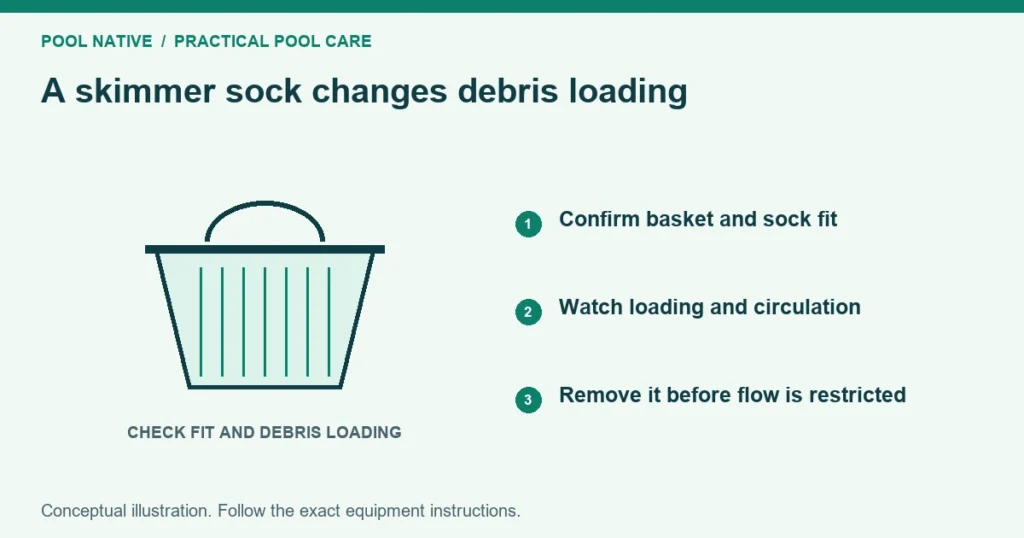
A skimmer sock can catch pollen and hair that would pass through a basket. The same fine mesh can also clog much faster than that basket. Its value depends on how quickly debris accumulates and whether you can inspect it before circulation suffers.
Try one as a monitored cleanup aid, not an unattended addition to the system. A clean sock that fits properly today may become restrictive during tomorrow’s pollen fall. Remove it if you cannot maintain reliable water flow.
What a skimmer sock actually catches
A skimmer sock is a fine mesh liner made for a compatible skimmer basket. Water passes through the fabric while some small debris remains inside. The basket still supplies the liner’s shape and support.
Poolmaster describes its basket liners as catching pollen, insects, hair and tree droppings. That describes debris capture, not a certified removal size for every product. Do not assume an unlisted micron rating from how fine the material looks.
The liner does not replace the filter, sanitizer or routine water testing. Dissolved contaminants can pass through it. If the pool is cloudy, catching visible debris may help housekeeping without resolving the cause of the cloudiness.
| Situation | Potential benefit | Main limitation |
|---|---|---|
| Fine floating debris passes through the basket | Captures some material before the pump and filter | Mesh can load rapidly |
| Hair collects around basket openings | Holds loose hair in a removable liner | Fit around the handle and rim still matters |
| Large leaves fill the skimmer | Collects leaves along with finer debris | Frequent emptying remains necessary |
| Pool will be unattended | Little opportunity to monitor loading | A bare, correctly fitted basket may be the better choice |
| Water looks dirty despite an empty basket | May catch visible particles reaching the skimmer | Does not diagnose chemistry or filtration problems |
Check compatibility before installing one
Choose a liner intended for your skimmer basket’s shape and size. A claim that it fits most baskets is not a guarantee for a particular assembly. Check the package restrictions and your skimmer instructions together.
Keep the basket in place. Do not stretch loose fabric across an open suction pipe or substitute a sock for a missing basket. A liner must not interfere with the basket seating, lid, weir or any float valve assembly.
Look at the underside and handle arrangement before use. The fabric should remain supported and secure without blocking a required opening. If it stretches loose, tears or pulls the basket out of position, remove it.
A skimmer liner is not automatically suitable for a pump basket. The location, basket design and suction conditions differ. Use a product only in the location its manufacturer approves.
A sock cannot compensate for low pool water or a skimmer drawing air. Correct those conditions before evaluating a liner. Otherwise, the trial starts with an existing circulation fault.
Run a clean basket comparison
Begin with the ordinary basket clean and correctly seated. Confirm the pool water level and normal circulation before adding anything. Otherwise, an existing flow problem can be mistaken for a sock problem.
Record the pump program and the usual signs of operation. These may include return strength, pump basket appearance and the flow reading if a suitable meter is installed. A filter pressure reading alone does not measure total flow.
Stop the equipment as directed by its instructions before handling the basket. Fit the clean liner, replace the basket and lid, then restart normally. Stay nearby for the first check rather than leaving immediately.
Compare operation at the same pump setting and valve positions. A noticeable loss of return flow, abnormal pump noise or new air needs investigation. Remove the sock and reassess instead of raising speed to conceal the restriction.
This comparison answers a narrow question: does this clean liner work acceptably in this basket under these conditions? It does not establish a safe cleaning interval for a later debris storm. Loading changes the result.
How often should you inspect it?
Inspect early during the first use and again as debris accumulates. Increase checks during heavy pollen, wind or leaf fall. There is no reliable universal number of days between cleanings.
A liner can look only lightly dirty on top while fine material blocks much of its wetted area. Check its condition after stopping the equipment according to the operating instructions. Do not wait for the pump to sound distressed.
Use a simple record for the trial:
- Pump program and start time.
- Type of debris and recent wind or pollen conditions.
- Time of each inspection and how much material accumulated.
- Any change in circulation before cleaning.
- Whether removing the liner restored ordinary operation.
If the useful interval is shorter than you can reliably manage, stop using the sock. Removing it is a reasonable outcome of the trial. It is not a failure to maintain the pool properly.
Clean, replace or discard?
Follow the instructions for the exact liner. Products differ in whether they are disposable or intended for repeated cleaning. Do not assume every stretch fabric sock has the same reuse allowance.
For a reusable product, remove collected material and rinse it as instructed away from the pool. Inspect the mesh, rim and seams before putting it back. Discard a liner that has holes, weak elastic or material that no longer rinses clear enough for its intended use.
Do not use an aggressive solvent or improvised chemical soak without manufacturer approval. Cleaning that weakens the fabric can create a loose piece near the suction path. Keep a normal clean basket available while a liner is being cleaned or replaced.
The cleanup benefit should be practical. If you spend more time nursing restricted flow than removing debris, change the approach. Surface netting and prompt basket emptying may suit that debris load better.
Do not turn a debris sock into a chemical feeder
Advice about dissolving a chemical in a sock is a separate question from using a skimmer liner. The chemical label must permit the application method. Equipment restrictions also apply.
For example, Pentair’s MasterTemp manual prohibits putting chlorine tablets or sticks in the skimmer. Water passing through the skimmer then travels toward the equipment. A fabric barrier does not remove that chemical exposure.
Do not place tablets, mixed chemicals or an improvised dose into a debris filled liner. If a label specifies a sock method elsewhere in the pool, follow that exact method and its circulation requirements. Do not automatically move it into the skimmer for convenience.
When removing the sock is the right decision
Remove it if the basket cannot seat correctly, the material pulls loose or circulation changes. Also remove it before an unattended period if rapid loading is possible. Do not make its presence part of a fixed routine regardless of conditions.
If flow remains weak after removing it, the liner was not the whole problem. Check the normal water level, basket condition and operating settings. A persistent suction problem needs its own diagnosis through the pool suction line troubleshooting guide.
The best result is straightforward: less fine debris reaches the equipment while circulation remains dependable. Keep the sock only while it delivers both. Debris capture alone is not enough.