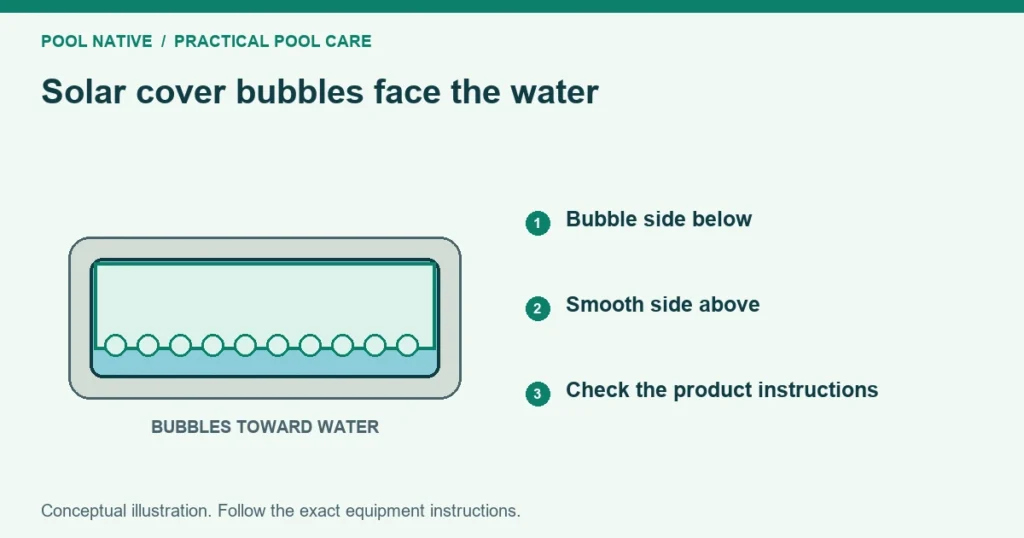
Put a conventional bubble solar cover on the pool with the bubbles down, touching the water. The smooth surface faces upward. Check the label first if your cover uses foam, a special coating or another construction.
Both ABGAL and Plastipack specify this orientation for their bubble blankets. Do not decide by which side is darker. Color and bubble shape are different product features.
How to identify the two sides
Look at an edge or a small section before unfolding the entire sheet. One face has the formed bubble shapes projecting outward. The other is the flatter face joining those pockets.
| Face | Position for a conventional bubble blanket |
|---|---|
| Raised bubble shapes | Down toward the water |
| Smooth sheet face | Up toward the air |
| Product label with different instructions | Follow that exact product’s directions |
Some bubbles are joined shapes rather than round dots. The same distinction between a formed face and a smooth face still applies. Do not puncture a pocket to identify it.
Check orientation before cutting
Lay the blanket correctly on the water before marking the final outline. This matters especially for kidney shapes, steps or asymmetric pools. Flipping a trimmed asymmetric sheet can put its extension on the wrong side.
Confirm the planned reel end too. A center mounted reel may need a specific fold allowance. Use the cutting guide before removing material.
If a precut cover appears to fit only upside down, stop and check the order and orientation. Send the supplier an overall photo. Do not enlarge cutouts until you know whether the sheet matches the pool.
If you have already used it upside down
Remove the cover completely using its approved handling method, then reinstall it correctly. Work with help if the wet sheet is awkward. Do not enter the pool beneath it to turn it over.
Inspect the material and fit while it is off. A period upside down does not by itself prove that the blanket is ruined. Nor is there a reliable universal percentage of lost heating to assign to that mistake.
If correcting orientation makes a custom cut shape unusable, ask the supplier about options. Do not stretch the sheet to reach a missing area. Avoid improvised patches that interfere with removal or circulation.
What orientation does not fix
Bubbles down will not correct a cover that is too large, badly folded or deteriorating. It also cannot create sunlight in a shaded pool. Use heating performance checks if the expected warmth has not appeared.
A little top water does not automatically mean the blanket is upside down. Rain, movement and fit can put water on top. Inspect the actual orientation and shape rather than inferring it from a puddle.
Keep the blanket clear of skimmer interference and follow the pool equipment instructions. Do not add weights to force it flat. Repeated bunching calls for a fit and handling review.
Keep the safety distinction clear
The correct orientation does not make a solar blanket a safety cover. Remove it completely before swimming and keep people and pets off it. Maintain the pool’s normal access barriers.
Protect the blanket from sunlight when it is folded or rolled off the water. The storage position has different heat conditions from floating use. The solar cover routine covers those daily handling steps.