Water bugs in a pool need two checks: identify the visitor, then assess the water. Scoop out the insects with a net, test the water, and look for algae or accumulated debris. A flying insect landing overnight doesn’t, by itself, prove that your pool needs shock.
The useful distinction is between an insect that visits the pool and a condition that helps it stay. Treating every arrival as a chemical failure can waste product while leaving the actual entry route unchanged.
Identify water bugs in your pool by behavior
Watch a live specimen through a clear container without touching it. Note which side faces upward, whether it swims below the surface, and how its legs move. Take a close photo beside a ruler if identification remains uncertain.
| Observation | Likely group | Useful distinction |
|---|---|---|
| Rows underwater with its back upward | Water boatman | Often has fine crosslines across the back; feeds mainly on algae and detritus. |
| Rows underwater while upside down | Backswimmer | A predator that can give a painful bite. Use a net. |
| Swims with a hard, beetlelike back | Aquatic beetle | Not enough evidence to call it a boatman; several beetle groups visit water. |
| Clusters on the surface and jumps | Possible springtails | Follow the surface visitor route rather than the swimming insect route. |
| Wormlike body falls from nearby plants | Possible caterpillar | Look above the pool and along the deck, not just in the water. |
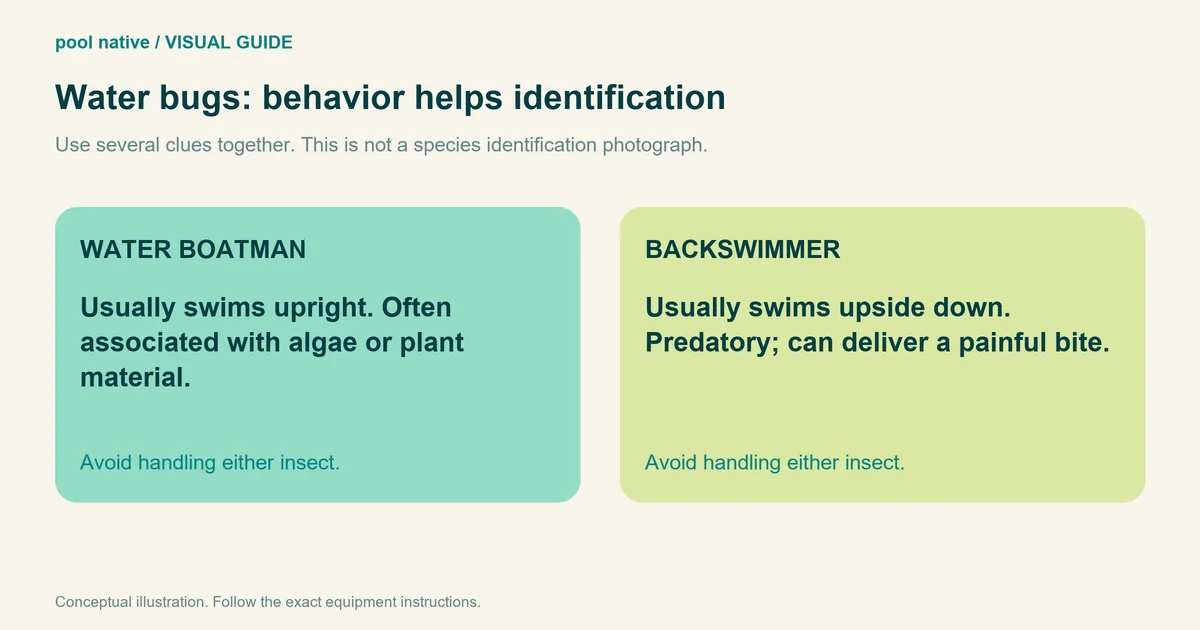
In US field guides, water boatmen usually means Corixidae. Backswimmers belong to Notonectidae. Some regional common names overlap, so swimming posture and a clear photograph are more useful than a nickname.
Color alone is a poor identification method. A tiny dark speck could be an insect, a mite, or debris. Don’t choose a pesticide from a vague description such as “little black pool bugs.”
Remove the insects without creating another water problem
Use a fine mesh net for small visitors. Collect floating leaves and insects before they sink, then empty the net away from the pool edge. A deep leaf rake and a flat skimmer net serve different collection jobs.
Remove settled debris with equipment suited to your pool surface. Check the baskets afterward, especially following a large arrival. Shut down equipment using its normal service procedure before opening a pump basket.
Don’t pour dish soap, cooking oil, household insecticide, or an improvised pesticide mixture into the pool. These aren’t substitutes for a labeled pool treatment. Soap can leave you with a separate foamy water problem.
Choose the next step from the water condition
The water is clear and the tests are in range
Remove the visitors and observe when new ones arrive. Water boatmen can fly to artificial lights and land in swimming pools. Repeated dosing won’t prevent an insect from flying over the fence.
Record arrivals after dusk, rain, landscape work, or nearby lighting changes. Check whether the same corner collects insects and leaves. That pattern can help you choose between improving collection and investigating an outside source.
You can see algae, slippery growth, or neglected debris
Deal with the underlying maintenance problem. Brush with bristles approved for the finish, remove debris, and use measured water results to guide treatment. Our pool algae guide separates the main growth patterns.
Don’t use a bug count to calculate chlorine. Pool volume, sanitizer type, stabilizer, test results, and the treatment label matter. Start with a properly collected water sample.
The water hasn’t been tested reliably
Test before deciding that the water is balanced. Clear water alone doesn’t establish suitable sanitizer or pH. Likewise, an insect isn’t a substitute for a chlorine reading.
Keep swimming decisions separate from insect removal. Follow the chemical label’s reentry conditions and the applicable water guidance. Never use “the bugs are gone” as a safety test.
Reduce repeated arrivals
Turn off unnecessary decorative lighting near the water when the pool isn’t in use. Keep essential access and safety lighting working. Repair damaged screens and remove accumulated plant debris from the deck.
Inspect nearby standing water and neglected containers. Empty containers that can safely be emptied, but don’t drain a swimming pool to solve an insect problem. Water on top of a cover needs attention too.
A correctly used cover can reduce some arrivals and falling debris. Its gaps, collected water, and operating instructions still matter. A floating solar cover isn’t a safety barrier.
Caterpillars and other occasional visitors
If caterpillars keep appearing, inspect overhanging foliage and the route across the deck. A pool treatment won’t stop new caterpillars falling from a plant. Collect them with a net rather than bare hands, particularly if they have hairs or spines.
Save a clear photograph for your local extension service if arrivals are heavy or the species is unclear. Avoid treating nearby vegetation until the pest and an appropriate control are identified. Protect the water from spray drift and runoff.
Surface clusters that jump, or larvae wriggling in stagnant water, need different identification from boatmen. Note the behavior instead of assuming every small visitor shares one cause. Keep routine skimming, brushing, and testing in your weekly care routine.


