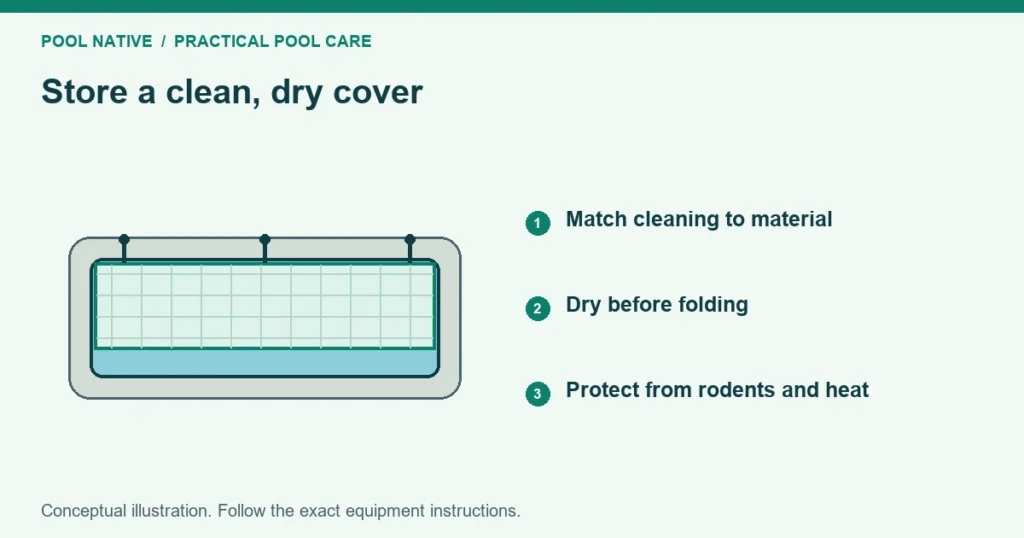
The best time to find a worn strap or blocked drain panel is before putting your pool cover away. Remove the water and debris first. Then clean, inspect, dry and fold the cover using the instructions for its material.
Storage is not the same for every cover. A mesh safety cover, coated winter tarp and floating bubble blanket have different cleaning and heat limits. An automatic cover normally stays installed in its housing and needs its own maintenance routine.
Prepare a clean handling area
Choose a smooth area large enough to handle the cover without dragging it across gravel or sharp edges. Remove twigs and grit from that area. Keep the dirty side away from garden chemicals, oil and hot equipment.
Have the supplied storage bag, approved cleaner and cover instructions ready. Arrange help for a cover that is awkward or heavy when wet. Keep children away from the open pool throughout the job.
Use the leaf removal sequence before releasing attachments. Pump off standing top water as the cover requires, while checking pool water beneath. Do not pull a loaded cover across the pool to empty it.
Match cleaning to the actual material
| Cover | Cleaning priorities | Storage concern |
|---|---|---|
| Mesh safety cover | Clear trapped debris and drainage pores as directed | Protect straps, mesh and hardware from abrasion |
| Solid safety cover | Clean both surfaces and the drainage area | Dry folds and protect coated fabric |
| Winter tarp | Remove organic debris with approved gentle cleaning | Avoid trapped moisture and sharp folded hardware |
| Solar blanket | Use its own care instructions and avoid damaging bubbles | Protect the rolled layers from sunlight and excess heat |
Meyco distinguishes its own fabrics: MeycoLite does not require scrubbing or powdering before storage. Its RuggedMesh and PermaGuard instructions call for mild detergent and drying. Those differences are a reason to identify the cover, not apply one brand’s routine to every material.
Rinse away loosened dirt and any approved cleaner thoroughly. Work gently around stitching, seams, drainage panels and worn areas. Aggressive scrubbing can turn a small defect into a larger one.
Do not improvise with bleach, solvents, pressure washing or household stain treatments. A stain remaining after approved cleaning does not necessarily mean the cover is unsafe. Fabric damage needs a separate assessment.
Inspect while the cover is spread out
Look at both sides in sections. Pay attention to the places that touched coping, steps, ladders and other raised features. Photograph damage with a wider view showing its location.
- Check fabric for holes, brittle areas and worn contact points.
- Inspect stitching and webbing for separation or fraying.
- Check buckles, springs and attachment points for distortion or missing pieces.
- Check drain panels for remaining blockage or damage.
- Record the model, identifying label and any repair history.
A patch that closes a hole does not automatically restore a safety cover’s performance. Send safety cover damage to the manufacturer or authorized dealer for a repair decision. Do that before storing it so the problem is not rediscovered during closing.
If an anchor sticks during removal, use the anchor troubleshooting guide. Keep a partly released cover from becoming an unattended opening. Do not force hardware merely to finish the storage job.
Let moisture leave before making the final bundle
Follow the material’s drying requirement and check folds, seams and straps rather than just the exposed center. Turn or rearrange the cover as needed in a suitable area. Avoid leaving a solar blanket folded in direct sun while waiting for it to dry.
If weather forces temporary packing, treat that as temporary. Reopen and finish the approved drying routine promptly when conditions allow. Do not put a damp bundle in an airtight container and assume the job is complete.
There is no reliable universal drying time. Shade, humidity, material and the amount of trapped water change it. Inspect the actual cover instead of using a fixed number of hours.
Fold without concentrating damage
Use the manufacturer’s folding method. An accordion fold can make a large cover easier to deploy next season, but the approved pattern controls. Avoid pulling straps across rough decking as you work.
Keep removable hardware together in a labeled container where the instructions permit removal. Protect fabric from sharp edges and do not lose the original arrangement. Never cut off fixed straps to make the bundle smaller.
Label the stored package with the pool end or orientation if that will help installation. Include the cover model, storage date and repair status. A small drawing of unusual steps or obstructions can prevent confusion later.
Choose the storage location
Use a clean, sheltered location that meets the cover’s temperature and ventilation instructions. Keep it away from rodents, sunlight, sharp tools and pool chemicals. Do not place heavy objects on top of the folded fabric.
Use the supplied bag when specified. A storage bag protects handling and organization, but it cannot make a damp or rodent exposed location suitable. Check the area occasionally rather than leaving it forgotten for the season.
For a solar blanket on a reel, fit the required protective storage cover whenever it is rolled outside. Read solar cover handling for daily use. Seasonal storage still needs the manufacturer’s cleaning and drying steps.
Before the next installation, open the package early enough to check repairs and missing parts. Confirm that deck or pool changes have not altered the fit. Replacement cover measurements are needed if the original geometry is no longer valid.