Pool heating time depends on the energy needed to warm the water and the heat actually reaching it each hour. The heater’s advertised size is only useful when you know whether it describes input or output. Heat escaping during the same period makes recovery slower.
Use the calculator for a planning estimate, then compare it with your own measured heating sessions. It assumes constant heater output and an optional constant average heat loss. It does not forecast changing weather or sunlight.
Calculate your heating time
Enter US gallons with Fahrenheit or cubic meters with Celsius. Use delivered heating output, in BTU per hour or thermal kilowatts. Electrical input kilowatts are not the same thing as thermal output from a heat pump.
The heat loss field is an optional estimate in the same power unit as heater output. Leave it at zero for an ideal calculation that excludes losses. A zero entry does not mean your outdoor pool loses no heat.
What the calculator does
For US units, required heat in BTU is approximately volume in gallons × 8.34 × the temperature rise in Fahrenheit. For metric units, required heat in kWh is approximately cubic meters × 1.163 × the rise in Celsius. These are practical water heating approximations.
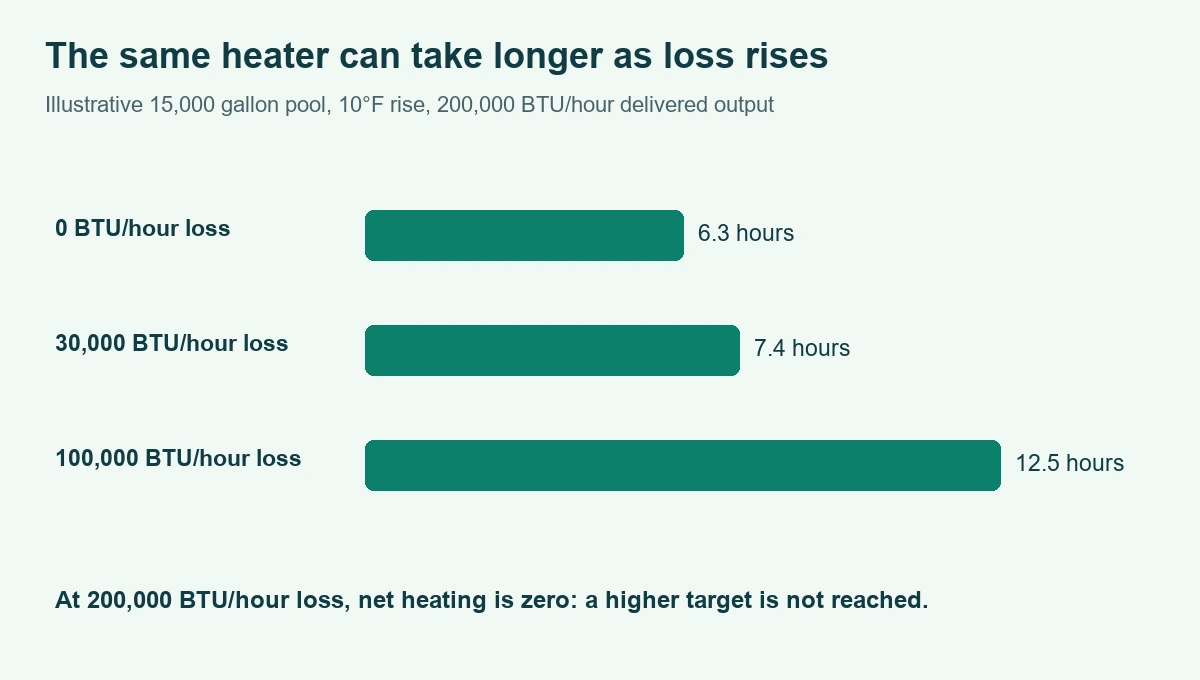
Estimated operating hours equal required heat divided by delivered output minus average heat loss. The subtraction happens before division. If heat loss equals or exceeds output, the model cannot reach a higher target temperature.
| Input | Example | Meaning |
|---|---|---|
| Pool volume | 15,000 US gallons | Actual water volume, not the pool’s maximum shell capacity |
| Current and target temperature | 70°F to 80°F | A 10°F water temperature increase |
| Delivered output | 200,000 BTU per hour | Heat supplied to the water |
| Average loss | 30,000 BTU per hour | An assumed load during the heating period |
This example needs about 1,251,000 BTU. Dividing by 170,000 BTU per hour gives about 7.4 operating hours. With no loss allowance, the same example gives about 6.3 hours.
The difference is useful for planning, but neither result is a promise. Output and loss change as water and air temperatures change. Run more than one reasonable scenario when timing matters.
Find the right output figure
Gas heater
Gas heater size often describes fuel input. Multiply input by the applicable thermal efficiency to estimate delivered output. For example, 250,000 BTU per hour input at 84% efficiency gives about 210,000 BTU per hour output.
Do not apply efficiency twice if the specification already lists delivered output. Use the exact model and its applicable rating. A generic efficiency estimate can distort the timing calculation.
Heat pump
Use heating capacity at conditions close to your expected air temperature, humidity and water temperature. A warm weather capacity rating may be much higher than a cool weather rating. The cold weather heat pump guide explains that distinction.
If only electrical input and COP are available for the same operating point, thermal output is input multiplied by COP. COP means heat delivered divided by electrical energy consumed. Do not combine maximum output with a COP measured at a different operating condition.
Electric resistance heater
Rated heating output in thermal kilowatts can be entered directly. Check that the rating applies to the installed electrical configuration. A shared word like electric does not make a resistance heater equivalent to a heat pump.
The heat pump versus resistance heater guide compares input, output and heating speed. Use heater sizing guidance when you are choosing equipment rather than evaluating a unit already installed.
Estimate heat loss without inventing precision
Ask an installer for a load estimate appropriate to your pool and planned season. Surface area, exposure, water temperature and cover use all matter. A fixed loss percentage cannot describe every pool or heating session.
You can also use careful observations to explore plausible scenarios. Record water temperature over a known interval with heating off, under safe normal operating conditions. Keep cover use, measurement location and weather notes consistent.
For example, a 15,000 gallon pool dropping 2°F over 10 hours represents about 250,200 BTU of net cooling. Dividing by 10 gives roughly 25,020 BTU per hour for that interval. It is an observation based estimate, not a guaranteed future heat loss.
Sunlight, rain, fresh water and different starting temperatures can change that result. A daytime observation may include solar gains that hide some losses. Do not carry one night’s estimate unchanged into every season.
Operating hours are not a calendar deadline
The result counts hours delivering the assumed heat. If the pump or heater schedule stops, the pool can continue cooling during the interruption. Dividing by your daily heating window does not capture that additional cooling.
A heat pump may also spend time defrosting or operating at reduced output. Automation may prioritize a spa or prevent heating outside selected hours. Check the actual schedule before planning a swim around the result.
Start earlier when the forecast is uncertain and monitor progress. Do not raise the setpoint far above the desired temperature to force faster recovery. That can produce an unwanted final temperature without increasing the available capacity.
Make the estimate more useful over time
Measure with the same thermometer after water has circulated enough for a representative reading. Avoid comparing a sunny surface measurement with a deeper shaded one. Record start temperature, finish temperature, actual heating hours and cover use.
If results repeatedly differ, revisit volume and delivered output before assuming equipment failure. Check whether weather or pump schedules changed. Repeated faults, poor circulation or unusual operation belong in a service investigation.
A suitable cover can reduce losses when the pool is unused. Follow its safety instructions and remove it completely before swimming. See solar cover use for handling and chemical care.
What this tool cannot decide
This calculator does not confirm that an installation is safe, that flow is adequate or that a heater suits your climate. It does not model solar collectors or establish a safe swimming temperature. Use it alongside the equipment manual and professional sizing advice.
To price the heat rather than its delivery time, use the pool heater running cost calculator. Keep the same volume and temperature assumptions when comparing results. Cost and recovery speed answer different parts of the buying decision.