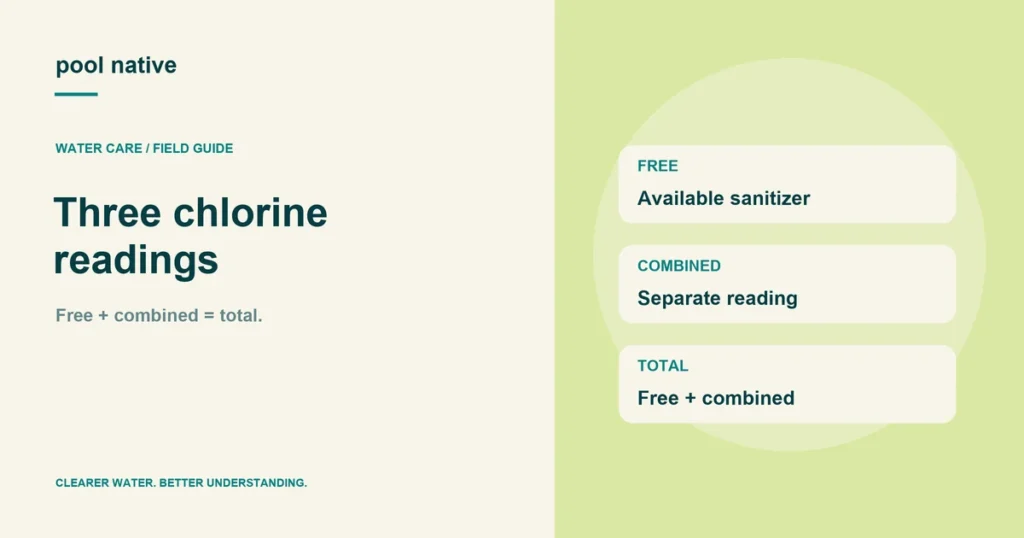
Free chlorine, total chlorine, and combined chlorine answer different questions. Free chlorine is the available residual measured for routine sanitizer management. Total chlorine includes that free residual plus combined chlorine detected by the test.
With compatible valid measurements, combined chlorine equals total chlorine minus free chlorine. Some FAS-DPD procedures measure combined chlorine through a separate step instead. Read the instructions before deciding whether subtraction is necessary.
A simple example
Suppose a reliable test gives free chlorine of 3.0 ppm and total chlorine of 3.4 ppm. The calculated combined chlorine is 0.4 ppm. Total chlorine is not an additional 3.4 ppm on top of the free chlorine.
Now suppose total chlorine is 3.4 ppm but free chlorine is only 0.4 ppm. That implies 3.0 ppm combined chlorine if the measurements are valid. The same total reading describes a very different sanitizer situation.
These are hypothetical arithmetic examples, not treatment targets. Use the chlorine operating guide to interpret a real result with your system and CYA level. A calculation cannot choose a safe swimming condition by itself.
Check what your kit reports
Some simple tests don’t separate free and combined chlorine. Others require a second reagent or titration step. A digital screen labeled chlorine may still need its method documentation to establish which measurement it displays.
Do not compare an OTO total chlorine result with a free chlorine result as though one must be wrong. First verify the measurement names. The testing methods guide explains why apparently similar kits can answer different questions.
Small differences can reflect measurement limits
Subtracting two broad color estimates can produce an uncertain combined chlorine value. For example, judging adjacent blocks by eye doesn’t create precision to two decimal places. Keep the reported result consistent with the method’s resolution.
Total chlorine should not be lower than free chlorine in a valid comparable result. A negative calculated combined value points to timing, reading, method, or interference issues. Don’t enter it as a real negative concentration.
Repeat questionable results from a fresh sample. Check the sequence and timing, particularly when a reaction is meant to be read promptly. Some nonchlorine oxidizers can interfere and require a specific test procedure.
What combined chlorine does and does not tell you
A persistent result can prompt investigation of contamination, oxidation, and water management. It does not identify every chemical species present or provide a complete air quality assessment. An outdoor pool smell cannot substitute for the test either.
Use high total chlorine with low free chlorine if that pattern persists. Don’t add a large shock dose solely from an uncertain subtraction. Confirm the measurement and follow a suitable labeled treatment program.
Record free, total, and combined readings in separate labeled fields. Note when combined chlorine was calculated rather than measured directly. That small distinction makes future comparisons much more useful.