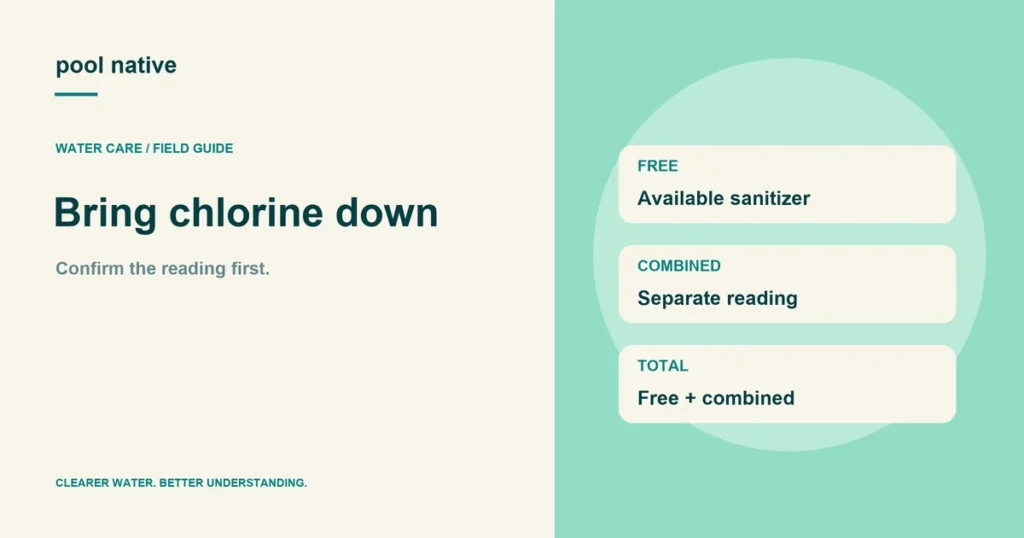
To lower genuinely high pool chlorine, first stop unnecessary sanitizer additions and confirm the reading with a suitable test. Then choose between allowing the residual to decline, a controlled water replacement, or a labeled chlorine reducer. The right route depends on the concentration, urgency, equipment, and pool structure.
Keep swimmers out until the applicable product reentry limits and normal water conditions are met. Don’t choose a universal number of waiting hours. Reentry after treatment depends on actual measurements as well as the label.
Confirm that chlorine is really high
Check the method’s range and any required dilution procedure. A color darker than the scale is not an exact concentration. A clear DPD sample can also be misleading if high chlorine bleaches the reaction.
Use the chlorine test troubleshooting guide when the result conflicts with dosing history. Don’t neutralize a guess. Record free chlorine, pH validity, CYA context, and the recent product additions.
Stop the continuing source
Review feeder settings, liquid dosing schedules, and salt generator output. Disable further sanitizer delivery using the equipment’s instructions while maintaining whatever circulation is required. Don’t open a pressurized chemical feeder to remove tablets casually.
Check whether someone made a manual addition while an automatic system kept dosing. Record the combined input. Correcting that operating mistake helps prevent a repeat after the water returns to its normal range.
Compare the correction routes
| Route | When it may fit | Main caution |
|---|---|---|
| Controlled waiting | No urgent need to reopen and monitoring is available | Decline depends on sunlight, CYA, demand, and conditions |
| Water replacement | Structurally safe and permitted, with suitable refill water | Groundwater, liner, discharge, and balance consequences |
| Labeled chlorine reducer | A measured correction is justified | Overdosing can remove the needed residual |
Sunlight can reduce chlorine, but it does not provide a guaranteed countdown. Maintain safe access control if changing cover use. Don’t invite swimmers to use up excess chlorine.
Use neutralizer cautiously
Select a pool product approved for this purpose and follow its dose and application directions. Calculate from a verified reading, actual volume, product strength, and chosen target. Use the label’s staged dosing and retesting instructions where provided.
Do not substitute household chemicals or mix a reducer with chlorine concentrate. Add each product separately as directed. Keep the label available if unexpected reactions occur.
Reestablish a normal residual
After correction, test again at the appropriate interval. Verify pH with a method valid at the resulting chlorine level. Restore automatic dosing only after reviewing its settings and confirming the cause of the excess.
Use routine chlorine interpretation to maintain the residual through the next operating cycle. Write down the correction in the maintenance log. A corrected number should be followed by a corrected routine.