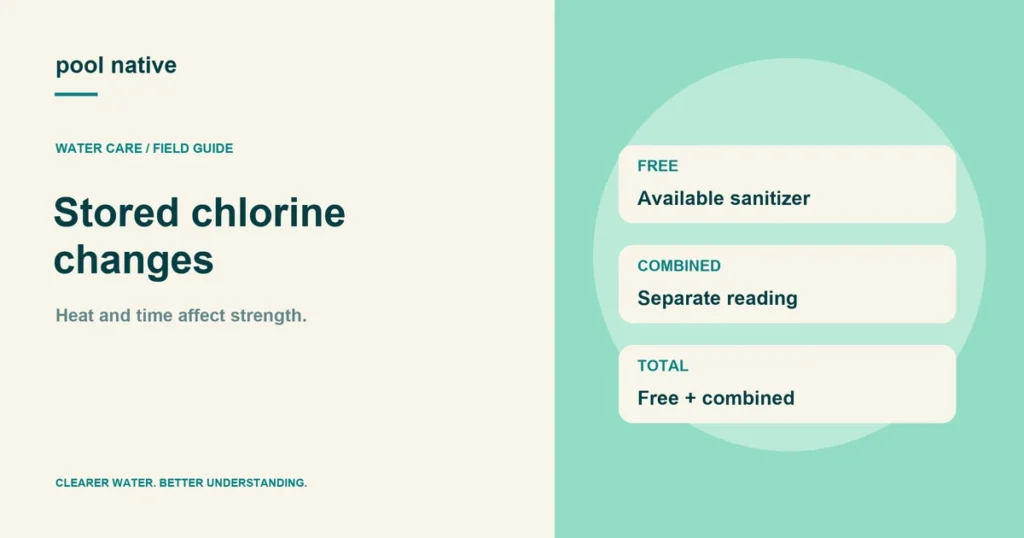
Liquid pool chlorine loses strength during storage, and heat accelerates the problem. Light, contamination, concentration, and container conditions also affect stability. There is no reliable rule that every bottle retains its labeled strength for the same number of months.
Use the manufacturer’s shelf life and storage instructions for the actual product. Keep the container label and lot information readable. Don’t convert a vague date code into an exact remaining percentage using an unrelated internet chart.
Why the original percentage may no longer describe the bottle
Sodium hypochlorite decomposes over time. The rate depends on storage conditions and the formulation, so elapsed age is only part of the story. A bottle kept hot for weeks may behave differently from stock stored correctly for the same period.
The label’s percentage also needs interpretation when calculating a dose. Weight percent, available chlorine, and trade percent are different conventions. Use the label based dosing worksheet rather than guessing from an unexplained percentage.
Check freshness before buying a large supply
Look for a clear date or lot code and ask the seller or manufacturer how to interpret it. Check storage conditions where possible. Buying a season’s supply only helps if you can store and use it within the product’s practical life.
Choose container sizes you can handle safely. Keep products in their original labeled containers and follow closure instructions. Don’t transfer pool chlorine into beverage bottles or improvised unmarked jugs.
Store according to the label
Use the specified cool, ventilated location away from sunlight, incompatible materials, and unauthorized access. Keep chlorine separate from acids and other chemicals. Don’t store it beside metal tools where leaks or vapors can cause damage.
Never mix old stock with a different product or formulation. Keep dispensing equipment clean and compatible. Follow local disposal guidance and the label for unusable stock rather than pouring it into a storm drain.
Investigate a weak treatment response
If a calculated addition produces less free chlorine than expected, check more than age. Pool volume may be wrong, the dose may be mismeasured, mixing may be incomplete, or the water may have substantial demand. The test itself may also be outside its range.
Repeat the measurement correctly before adding more. A clear test after chlorination can be caused by high chlorine bleaching, which would make a larger dose the wrong response. Don’t use odor to judge concentration.
If strength confirmation matters, ask the supplier or a qualified testing service about an appropriate assay. A routine pool comparator is not designed to measure concentrated stock directly. Don’t improvise a large dilution and treat it as a precise laboratory result.
Keep a useful stock record
Record purchase date, lot, first use, storage location, and any known heat exposure. Use older suitable stock first without mixing containers. Compare treatment records only after accounting for water conditions and dose.
Combine this information with the maintenance log. A pattern of poor response from one lot may justify replacing it, but it still doesn’t establish an exact remaining strength. Use verified inputs for the next chlorine adjustment.