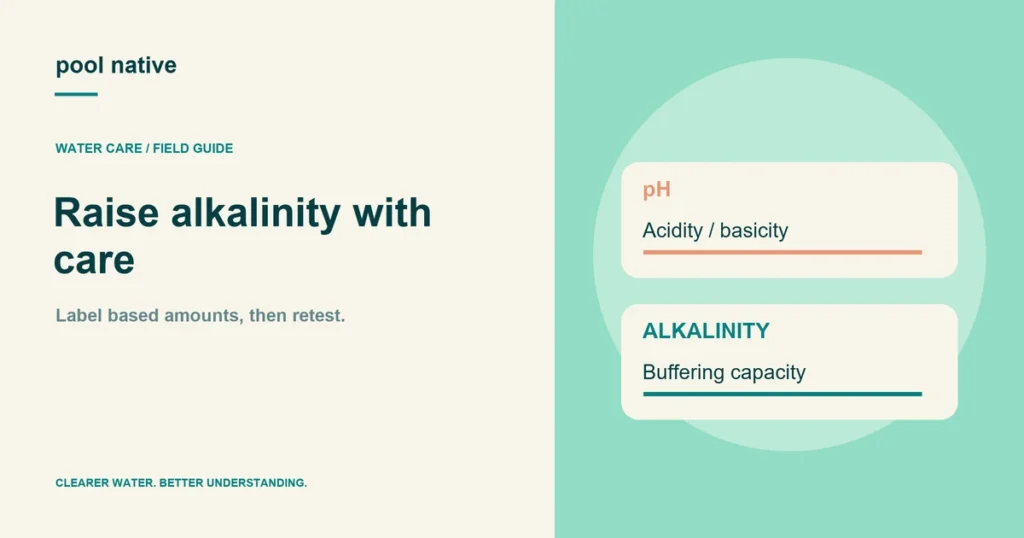
Sodium bicarbonate is commonly used to raise total alkalinity in a pool. Before adding it, confirm the reading and choose a target that suits the sanitizer, finish, and wider water balance. Low pH alone does not prove that alkalinity needs increasing.
Use a suitable pool product and its label instructions. The amount depends on water volume, the intended increase, and product purity. Baking soda and soda ash are not interchangeable doses.
Check pH and the reason alkalinity fell
Repeat an unexpected result using the correct sample volume and endpoint. Review recent acid additions, acidic sanitizer use, dilution, and fill water. If automatic equipment is adding too much acid, correct that source as well.
Read pH alongside alkalinity. A pool with low alkalinity but already high pH needs a coordinated plan. Use the combined reading guide instead of treating each number as an isolated problem.
Calculate from a labeled reference
Use the dose table for the exact product. Scale the reference amount to your pool volume and required increase only where the instructions permit that relationship. Keep pounds, ounces, kilograms, and liters clearly separated.
For a hypothetical arithmetic example, suppose a label calls for 1 unit of product for a 10 ppm increase in 10,000 gallons. A 15,000 gallon pool needing that same increase would require 1.5 units. Replace those reference values with the actual label; they are not a universal dose.
Measure the product rather than estimating part of a bag. If pool volume is uncertain, improve that estimate before attempting a large correction. A consistent volume error affects every chemical addition.
Add, circulate, and retest
Follow the label’s addition method and any instructions about dilution or staged application. Keep chemicals separate and use dedicated measuring equipment. Avoid leaving concentrated material on the pool surface.
Allow the specified circulation period, then test alkalinity and pH again. Don’t add the remaining predicted amount automatically if the measured response differs. Check the inputs and technique first.
Avoid the common overshoot cycle
Adding too much bicarbonate can raise alkalinity beyond the intended range and contribute to a higher pH tendency. Correcting that excess may require acid, which changes both measurements. That creates avoidable work and chemical expense.
Use bicarbonate versus soda ash to select the compound that fits the actual goal. Don’t use alkalinity increaser as a treatment for algae or as a substitute for chlorine. Clear water and adequate sanitizer remain separate requirements.
Confirm the correction holds
Record the starting value, product amount, and follow up readings. Watch the trend through ordinary operation and refill events. Repeated losses point toward ongoing acid input, dilution, or a testing issue.
Keep those observations in the pool maintenance log. If the readings remain difficult to reconcile, seek a full water assessment rather than continuing a cycle of bicarbonate and acid additions.