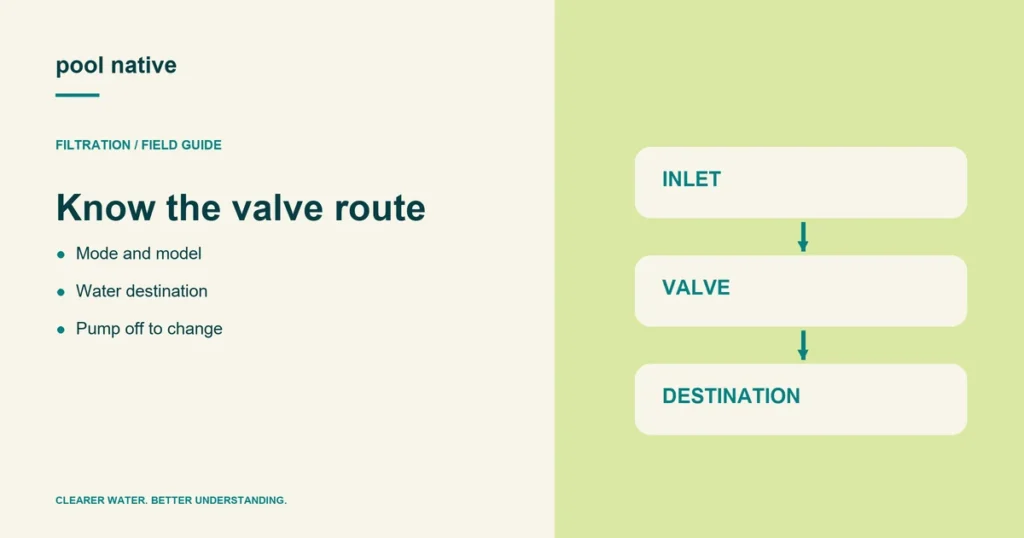
A pool multiport valve chooses where water travels through or around the filter. Its labels describe different flow paths, not different pump speeds. Stop the pump before changing positions and use the instructions for the exact valve.
Not every filter has a multiport valve. Some use a slide valve, and many cartridge systems have no equivalent control. Identify the installed equipment before following a six position sequence.
Common pool multiport valve settings
| Setting | Typical path | Purpose |
|---|---|---|
| Filter | Through filter media, then back to pool | Normal filtration and compatible routine vacuuming |
| Backwash | Reverse through the media, then to waste | Remove accumulated material on compatible filters |
| Rinse | Normal direction through media, then to waste | Clear residual dirty water after backwash where specified |
| Waste | Bypass filter, discharge water | Approved draining or waste vacuuming |
| Recirculate | Bypass filter, return to pool | Circulation without filtration where appropriate |
| Closed | Flow path closed | No pump operation in this position |
Your valve may use different wording or omit some positions. A storage or winter position isn’t a normal operating mode. The manufacturer’s port diagram controls if the label is unfamiliar.
Identify the valve separately from the filter
Record the valve model, port markings, and filter model. Sand and DE applications can use different connections and internal routing. A valve that physically resembles another one isn’t automatically an interchangeable replacement.
Photograph the normal position and labeled plumbing. That record is useful after maintenance or a service visit. Don’t infer the normal route from another owner’s handle direction.
Change settings with the pump stopped
Prevent a timer or automation command from restarting the pump during the change. Follow any additional pressure relief steps in the manual. Fully seat the handle in the intended position before normal startup.
Never run the pump in Closed or deliberately between operating positions. Don’t force a stiff handle. If the valve will not seat correctly, stop and arrange service.
For cleaning, follow the correct backwash sequence. The presence of a Rinse label does not make its duration universal. DE filters may also need a new coating afterward.
Keep bypass and discharge decisions separate
Recirculate returns unfiltered water to the pool; Waste removes it from the pool. Confusing them can either leave debris circulating or lower the water level unexpectedly. Use the filter versus recirculate comparison when deciding whether bypass is appropriate.
Before using Waste, confirm the discharge destination and hose arrangement. Watch the water level throughout. A valve setting doesn’t authorize the disposal route.
For settled debris, see vacuuming to waste. Cartridge systems without a suitable bypass need another compatible arrangement. Removing their cartridge does not create a waste outlet.
For a purchase, match the replacement valve to the filter and plumbing. For water around the stem, follow the handle leak checks before ordering seals.
Maintenance begins with the symptom
Inspect for external leakage, continuing waste discharge in Filter mode, or a handle that won’t seat. Water leaking from the backwash line during filtration points to a different route than a cracked external fitting. Record when it occurs.
Use the exact replacement parts and prescribed service method. Internal seals may be separate parts or part of an assembly. Don’t assume every spider gasket should be glued or lubricated the same way.
After maintenance, verify normal filtration, pressure, and return flow without unintended discharge. Leave a clear record of the normal operating position. That simple reference prevents the next user from guessing.