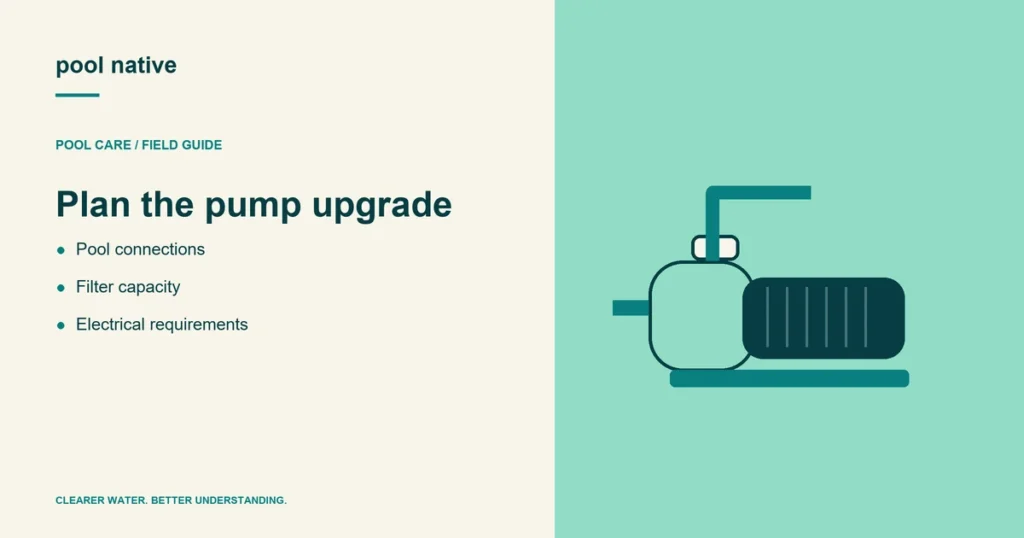
An above ground pool pump upgrade should solve a specific limitation without exceeding the rest of the system’s capabilities. Start with the current symptom, pool model, filter, and connections. A larger advertised flow number is not enough to choose a replacement.
Weak circulation may come from a dirty cartridge, air, a kinked hose, or an obstruction. Correct those problems before deciding the original pump is too small. Otherwise, a replacement can inherit the same restriction.
Define what the upgrade needs to improve
| Your complaint | Check before shopping |
|---|---|
| Flow has gradually weakened | Filter condition, basket debris, air, and hose restrictions. |
| A cleaner will not operate | Its required flow and connection arrangement, not merely pump horsepower. |
| The filter needs frequent attention | Debris load, cartridge condition, and whether greater filter area would help. |
| Water stays green or cloudy | Water testing and treatment alongside circulation; a new pump does not replace sanitizer. |
Write the desired improvement in one sentence. For example, you may want a filter that handles seasonal debris with less frequent cleaning. That is a different purchase decision from needing an approved flow range for a particular cleaner.
Compare system flow with system flow
Some packaged units list both pump flow and system flow. The larger figure should not be treated as the flow through the assembled filter installation. Compare like specifications across candidates.
For example, Intex lists the SX2800 at 2,800 gallons per hour pump flow and 2,150 gallons per hour system flow. Those are manufacturer ratings, not measurements from your pool. Added hoses, fittings, and accessories can change the operating result.
Dividing pool volume by rated flow can help compare schedules on paper. It does not establish that every part of the pool receives equal circulation or that the water is sanitary. Keep water treatment and debris removal in the plan.
Plan the above ground pool pump upgrade as a system
Check the pool manufacturer’s permitted equipment and connection arrangement. Then check the filter’s flow limits, hose specifications, and any attached heater, chlorinator, or cleaner. The replacement must fit all relevant limits.
A larger pump attached to the old filter may be a poor combination. A complete matched pump and filter package can simplify that match, but still needs pool compatibility checks. Package marketing does not approve every pool wall fitting.
Preserve the intended suction outlets and protective screens. Do not remove a safety component or cap one of two suction connections to simplify plumbing. Have an appropriate installer resolve a layout that does not match the documented system.
Map the hose sizes and connection styles before ordering. If the replacement crosses brands, use the Intex and Bestway compatibility checks. Matching a diameter is only the first check.
Include the work around the pump
Budget for the correct hoses, valves, seals, filter media, and permitted discharge arrangement. Allow enough space to service the filter and open covers. Confirm the equipment’s required position relative to the pool and its electrical supply.
Do not solve a cord reach problem with an improvised extension arrangement. The model instructions and local electrical requirements control the installation. Electrical work belongs to a qualified person.
Consider ongoing work as well as purchase cost. A sand system needs a suitable backwash route; cartridges need cleaning access and eventual replacements. Choose the maintenance process you can actually carry out.
Check the installed result before calling it an improvement
Follow the new unit’s filling, air removal, and startup procedure. Confirm stable circulation, leak free joints, and normal filter readings. Save the clean operating baseline and the final schedule.
Verify each accessory within its permitted operating range. Then keep testing the water and watching debris pickup under normal use. Your written improvement goal provides a better verdict than the size of the new pump label.
If joints leak after the change, follow the hose connection troubleshooting route. Do not compensate by overtightening plastic fittings.