Pool covers can reduce evaporation, intercept debris, support seasonal care, or form part of a safety barrier. The same cover may do several jobs, but its appearance does not establish which ones. Choose the required function first, then confirm the exact product and installation.
A floating thermal blanket is a different product from a fitted safety cover. A motor makes a cover easier to move; it does not, by itself, prove safety compliance. Those distinctions help prevent buying a convenient cover for the wrong job.
Choose the job before choosing the material
Write down your main problem: heat loss, evaporation, leaves, seasonal closure, or restricting access. Then identify which secondary benefits matter. If safety is essential, verified safety suitability belongs at the start of the search.
| Cover description | What the description tells you | What still needs checking |
|---|---|---|
| Solar or thermal blanket | Intended to help manage surface heat and evaporation. | Handling, fit, storage, and safe removal; do not assume a safety barrier. |
| Mesh | A permeable material lets water pass through. | Light and debris exclusion, anchoring, and any claimed safety certification. |
| Solid | The main material limits water passing through it. | Drain panels or pump requirements, support, and the product’s intended function. |
| Automatic | A powered mechanism moves the cover. | Material, safety status, installation geometry, controls, and servicing. |
| Safety cover | A specific safety claim that needs documentation. | The applicable standard, exact model, correct installation, condition, and local requirements. |
These descriptions overlap. A safety cover can be mesh or solid, and an automatic cover can have a solid surface. Comparing them as five mutually exclusive choices can obscure what you are actually buying.
Verify safety claims for the installed cover
Ask for the exact product documentation behind a safety claim, including the applicable standard and installation requirements. In the US, ASTM F1346 is commonly referenced for pool safety covers. Confirm the local requirements for your pool rather than assuming a cover replaces fencing.
Fit matters as much as the product label. Gaps, unsuitable anchors, damaged fabric, and an incomplete closure can undermine the intended protection. A 2025 CPSC recall of certain retractable covers specifically concerned gaps caused by incorrect installation.
Do not test a cover’s strength by walking on it. Keep children away from controls and maintain the other required barriers. Safety equipment provides layers of protection alongside active supervision; it does not make a pool childproof.
For the broader plan, review residential pool safety and access. The cover should work with that plan, including how access is controlled when it is open, damaged, or being serviced.
Understand what heat and water savings depend on
Evaporation carries water and heat away from an uncovered surface. A suitable cover reduces that pathway while it is in place. How much you save depends on climate, wind exposure, heating, use, and how consistently you cover the pool.
Do not treat a manufacturer’s best case saving as a prediction for your home. Compare covered hours as well as cover specifications. A difficult blanket that stays on its reel provides little benefit during the hours it is unused.
Mesh drainage and evaporation control are different functions. A cover chosen mainly to pass rainwater through should not be assumed to perform like a continuous thermal barrier. Check the relevant performance claim rather than inferring it from the word cover.
Decide how rainwater and debris will leave
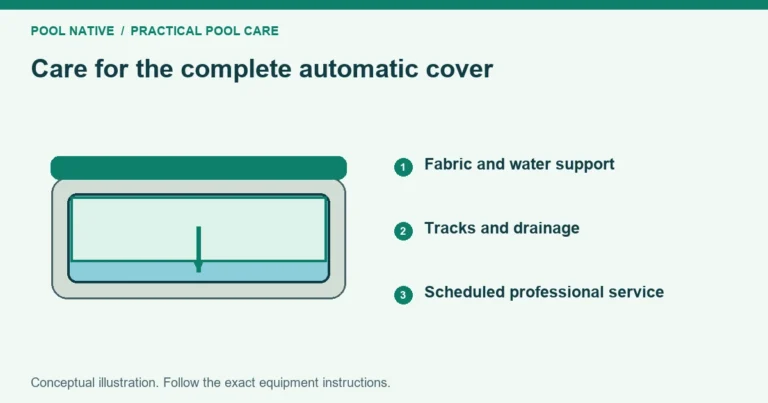
On a solid surface, rain needs a planned removal route. That may be an approved pump or an integral drainage arrangement. Check the cover manual before placing weight on the fabric or changing its support.
Mesh lets water through, but debris can still collect on top and water can raise the pool level below. It does not eliminate seasonal inspections. A drain panel also needs to remain clear enough to do its job.
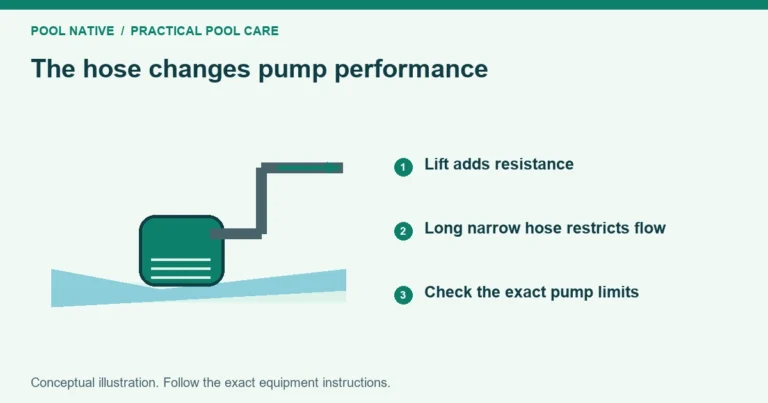
For a cover requiring pumped removal, choose a compatible cover pump and discharge route. Keep the outlet from sending water back toward the pool, buildings, or an unsuitable neighboring area. Check local drainage requirements.
Standing water above a cover can itself create a hazard. Do not leave access unsecured while waiting for it to drain. If a cover pump stops working, address both the water and the equipment fault.
Check the pool shape and surrounding space
Record steps, raised walls, ladders, rails, water features, and changes in deck level. These affect how a cover fits and moves. A simple length and width measurement may miss the details that determine a safe installation.
Ask the installer how the cover accommodates each obstruction. Confirm anchor locations, track clearance, storage space, and access for repairs. Avoid a layout that makes routine removal awkward enough to discourage use.
For portable or above ground pools, use a cover intended for the exact structure. Do not add improvised deck anchors or tension loads to a frame without approval. The pool and cover requirements both apply.
Make daily operation practical
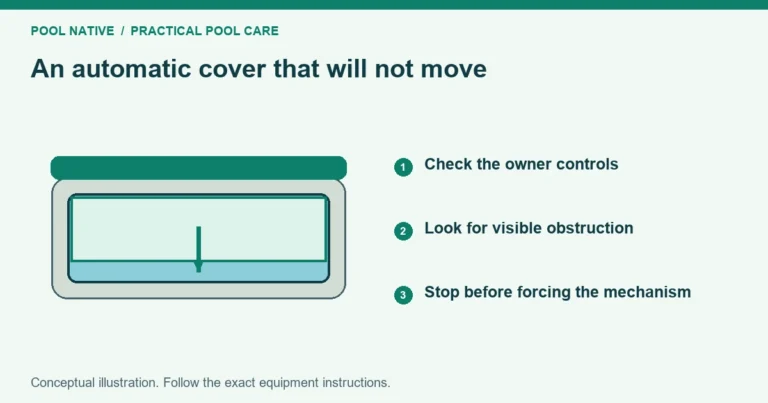
Before opening a cover, follow its instructions for removing water and debris. Confirm nobody is in the pool and clear anything that could obstruct travel. Keep the entire movement in view when using powered controls.
Do not force a crooked, jammed, or partly detached cover. Stop and arrange service. A mechanism that moves again after repeated attempts has not necessarily been repaired.
Remove floating blankets fully before swimming and store them as instructed. Do not allow swimming underneath a partly removed cover. Keep the storage arrangement from obstructing paths or access equipment.
After adding chemicals, follow the treatment label and cover instructions before reclosing. Do not borrow a waiting period from a different cover manual. Water treatment and fabric compatibility need to be considered together.
Plan winter care before closing the pool
Ask whether the selected cover is intended to stay installed through your winter conditions. Check snow, ice, wind, and water support requirements. Automatic operation and winter suitability are separate questions.
Do not lower the pool water to a generic level without checking the cover and pool requirements. Some systems depend on water beneath the fabric for support. A leaking pool can therefore become a cover problem too.
Record how the pump, controls, and removable parts should be protected from freezing. Arrange inspections during long absences. A winter cover is equipment left in service, not a reason to stop checking the pool.
Keep a short inspection record
Check fabric, seams, straps, anchors, tracks, and closure as applicable. Note accumulated water, unusual slack, wear points, and the pool water level. Keep the model, installation paperwork, and service contact together.
Recheck after severe weather and whenever operation changes. If safety performance is uncertain, secure access by other appropriate means until the defect is resolved. The useful cover is the one that remains suitable, usable, and maintained throughout its service.