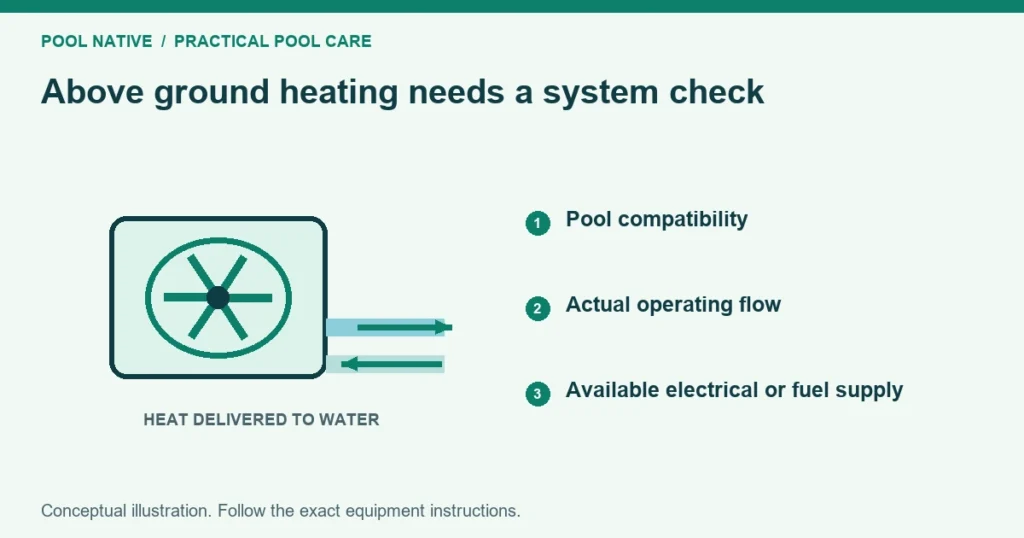
An above ground pool heater must match the pool’s construction, circulation system and available utilities. A unit advertised for a similar gallon capacity may still be unsuitable. Check compatibility before comparing heating speed or price.
A permanent steel wall pool, a seasonal frame pool and a small inflatable pool are different installations. Their hose connections, operating limits and storage requirements vary. Do not assume one heater arrangement transfers between them.
Start with the pool and filtration details
Record the pool model, actual water volume and normal circulation setup. Note hose sizes, connections and the filter system’s operating flow. Keep the pool and pump instructions available for the installer.
Check whether the manufacturer permits an added heater and under what conditions. A minimum flow requirement can rule out a small filter system. A maximum flow or pressure limit matters too.
Use pool filter hose sizing to identify connections accurately. Matching external hose diameter is not enough to establish thread or pressure compatibility. Avoid improvised adapters that strain fittings or leak.
Choose the heating method around use
| Method | Practical fit question |
|---|---|
| Heat pump | Can it provide enough output in your swimming weather with the available electrical supply? |
| Gas heater | Is the pool arrangement approved and is adequate fuel service practical? |
| Electric resistance | Is its thermal output enough, and can the electrical installation support the input? |
| Solar collectors | Is there suitable exposure, area and a compatible circulation design? |
| Floating cover | Can it reduce losses while being removed completely for swimming? |
A cover can support any suitable heating method, but it is not a powered heater. See solar cover selection. Do not treat a bubble blanket as a safety barrier.
If you want occasional rapid heating, calculate that recovery requirement. If you swim daily, maintaining temperature may be a different design goal. The heating overview compares those patterns.
Check the energy needed before buying a small unit
Hypothetical example: 5,000 US gallons rising by 10°F need about 417,000 Btu, or 122 kWh of heat. A heater delivering 3 kW would need about 41 operating hours with no losses. Real outdoor losses can extend that substantially or prevent reaching the target.
That example is not a recommendation for a particular appliance. It shows why a small electric heater can run for a long time without an obvious temperature change. The label electric does not guarantee rapid heating.
Use the heating time tool with actual output. For heat pumps, choose output at relevant air conditions. Do not use electrical input as though it were thermal output.
Verify actual flow through the heater
A pump’s maximum advertised flow is not necessarily the flow after its filter, hoses and heater are connected. Added resistance reduces the system’s delivered flow. The installer should confirm operation within the heater’s range.
A dirty filter can reduce flow further. Check normal maintenance before assuming a larger heater is needed. Do not bypass a flow switch or remove the filter as a permanent fix.
Some heaters require a designed bypass or a particular plumbing elevation to remain full of water. Follow the exact diagram. Valve positions and loop dimensions from another model are not universal.
The return water may feel only slightly warmer even when heating works. Pool heating depends on total heat added over time, not making one return jet feel hot. Slowing flow below the required range is not a safe shortcut.
Check water chemistry compatibility
Confirm the heater’s permitted sanitizer, salt and water balance conditions. A titanium component does not by itself prove the whole unit is approved for every salt pool. Read the complete model specification and regional manual.
Place chemical dosing equipment as the heater and treatment system require. Prevent concentrated treatment from entering equipment in an unapproved way. Have the installer document the arrangement.
Keep testing after heating starts. Warmer water and changed cover use can alter demand. Use water testing rather than adjusting treatment by guesswork.
Provide a proper equipment location
Heat pumps need the specified airflow and service clearances. Gas units need their approved combustion and exhaust arrangement. A compact resistance assembly may have its own dry enclosure requirement.
Do not hide equipment beneath a deck or inside a storage box without approval. Keep it away from access routes that create a climbing aid. Consider drainage, noise and the route of hoses and cords.
Support equipment on its required base, independently of a portable pool frame. Do not hang a heavy unit from a pool wall. Keep connections from carrying structural loads.
Electrical and gas work need the correct installation
Use equipment approved for the location and supply. Voltage, frequency, circuit protection and grounding requirements differ by product and region. A plug fitting into a receptacle does not prove the circuit is suitable.
Have the required electrical or gas work performed by appropriately qualified trades. Do not use an extension lead to overcome a permanent supply problem. Follow the exact appliance restrictions.
Never use a household immersion heater, engine heater or camping water heater as a substitute for approved pool heating equipment. Their intended application and protections differ. Choose a system designed for the pool use.
Plan the end of the season
If the pool is dismantled, decide how the heater and connections will be drained and stored. A fixed appliance may remain installed but still need winterizing. Follow each component’s instructions.
Do not leave trapped water in equipment because the pool itself has been emptied. Use heater winterizing alongside pool draining for storage. Preserve plugs, unions and the installation record for spring.
Before purchase, ask the supplier to confirm pool compatibility, installed flow, utilities and cold weather plan in writing. Then compare the full installed cost. A heater is useful only when the whole setup can operate correctly.