Choose a solar pool cover you can fit properly, remove completely and replace consistently. The thickest blanket is not automatically the best choice for your pool. Its size, material, reel compatibility and storage needs should work as one setup.
This guide covers floating heat retention blankets. For a winter tarp or anchored safety cover, use winter cover selection or mesh versus solid safety covers. A solar blanket does not provide their safety or seasonal functions.
Start with the job you need it to do
Write down whether your main goal is reducing overnight heat loss, improving an unheated pool’s warmth or reducing evaporation. Those goals overlap, but they do not guarantee the same result. A cover cannot promise a chosen swimming temperature during poor weather.
If a heater already maintains the pool, reducing surface losses can reduce the heat it needs to supply. If the pool is shaded and unheated, a cover has less incoming sunlight to work with. Compare heating methods if temperature certainty matters.
Consider how often the cover will actually be used. A physically difficult blanket may stay on the reel. Include the person doing the work in the selection, not just the person placing the order.
Measure the usable shape and plan removal
Record maximum water surface length and width, steps, curves and fixed obstructions. Check the product’s actual dimensions and trimming rules. A nominal pool size is not always the final blanket size.
Decide where a reel can stand and where the full roll will be stored. Include handles, supports and the space needed to move it. A reel that fits across the water may still block the only practical walkway.
For an irregular pool, ask how projections will fold during rolling. Some layouts need a designed split arrangement or a different reel position. Do not cut the cover into pieces before confirming how they will be handled.
Use staged trimming after choosing the blanket and reel. Cutting an asymmetric shape upside down can leave a sheet that no longer fits when corrected.
Compare material claims carefully
| Product detail | Useful question |
|---|---|
| Light transmission or opacity | Is there data for this exact material and the intended heating goal? |
| Thickness | What is measured, and does the reel support it? |
| Bubble construction | Is it compatible with the reel’s stated blanket type? |
| Reinforced or finished edge | Can it be trimmed, and how are attachments installed? |
| Chemical and temperature limits | Can your normal pool care meet them? |
| Warranty | Which failures are covered and how does the credit decline? |
A color name alone is a poor performance specification. Clear, blue, reflective and opaque materials handle sunlight differently. Ask for evidence about the actual product rather than assuming every dark blanket heats better.
Transparent materials can admit sunlight to the water. Reflective designs may prioritize limiting solar gain or retaining existing heat. Match the stated purpose to whether you want a warmer pool or simply lower losses.
Do not buy based on a universal temperature increase. Weather, exposure, pool volume and use vary too much. Performance checks explain how to judge results without a misleading surface reading.
Understand mil and micron labels
A mil is one thousandth of an inch, not a millimeter. One mil equals 25.4 microns. Thus 12 mil is about 305 microns, while 16 mil is about 406 microns.
Check how the manufacturer defines its thickness measurement. A series number is not necessarily a direct thickness value. Compare specifications rather than assuming a larger model number means a thicker sheet.
More material can change weight, stiffness and the size of the stored roll. It does not establish a guaranteed lifespan or heating advantage. Handling and chemical exposure still matter.
Match the entire reel system
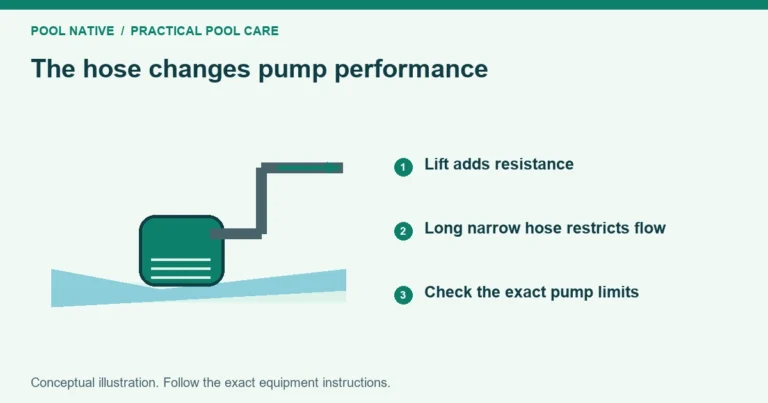
Check the permitted blanket width, length, wet weight, thickness and bubble type. Confirm both the tube set and the end supports. A reel’s maximum width alone is not a complete capacity rating.
For example, FeherGuard publishes separate limits for different tube sets within the same reel family. Its current instructions also state a recommended blanket thickness. Do not extend a tube beyond its required overlap to gain a few extra inches.
Use the reel selection guide before buying a thicker replacement blanket for an existing reel. A setup that handled the old sheet may not be rated for the new one.
Budget for the complete setup
Include the blanket, compatible reel, attachment kit and protective storage cover. Add installation help if the pool shape or mounting needs it. Check shipping and return conditions before cutting the material.
Compare replacement cost under several possible service lives rather than assuming the warranty length is the lifespan. A prorated warranty may provide a declining credit. It may exclude overheating, chemical damage or ordinary wear.
Hypothetical example: a $180 blanket lasting three seasons costs $60 per season before accessories. At two seasons it costs $90 per season. Those figures illustrate the calculation, not a prediction for a particular product.
Read care requirements before buying
Confirm that you can protect the folded or rolled blanket from sunlight immediately after removal. Check the required cleaning and seasonal storage conditions. An outdoor blanket can still be damaged by heat concentrated in a roll.
Review the acceptable water conditions against your pool’s treatment routine. Do not lower necessary sanitizer protection to accommodate an incompatible blanket. Ask the supplier about compatibility before purchase if the requirements conflict.
Keep the receipt, product label and warranty instructions. Photograph the initial fit and setup. That helps with both correct use and a future material claim.
A practical final choice
Choose the product that meets the fit and handling requirements with documented care limits you can follow. Prefer clear specifications and accessible support over unsupported longevity promises. There is no single best thickness or color for every pool.
This is a selection framework, not a claim of hands on testing of named blankets. Once installed, follow the daily use routine. Consistent coverage and protected storage are part of the purchase decision.