Stop an automatic pool cover when it begins opening or closing more crookedly than usual. Do not pull one side straight while the motor runs. A changing lead edge can signal uneven resistance, worn components or an alignment problem that needs service.
Keep the pool secured if the cover stops partly open. Do not swim beneath the remaining covered area. A cover that has left its track or exposed an unintended gap should not be treated as a working safety barrier.
Decide whether this is a new change
Some pool and cover geometries have an installer documented travel pattern. Compare the current behavior with that established pattern rather than demanding a perfectly square appearance at every instant. A new or worsening difference still needs investigation.
There is no safe universal number of inches of skew for every system. Track spacing, fabric arrangement and mechanism design differ. Ask the installer what normal travel looks like for your installation.
If you have no baseline, record the present condition without repeatedly operating it. A wide photograph shows more than a close image of one rope. Note which direction produced the unevenness.
Use the timing to narrow the question
| Pattern | Information it gives the technician |
|---|---|
| Uneven from the start | Initial alignment, fabric roll or drive arrangement may need review |
| One side hesitates at the same location | Check that track section and nearby contact points |
| Skew grows as travel continues | Unequal resistance or takeup may be accumulating |
| Problem occurs in only one direction | Opening and closing loads differ |
| Change follows a storm or pool draining | Debris, top load or missing water support may matter |
| Edge leaves track or rope looks damaged | Stop operation and arrange repair |
These are clues, not confirmed diagnoses. Different component faults can produce a similar visible angle. Do not shorten a rope based only on which corner appears ahead.
Check loads before mechanical adjustments
Look for water, leaves, toys or other objects on the cover and in its path. Remove only accessible debris using the approved method. Do not drag a heavy wet load toward the housing by operating the cover.
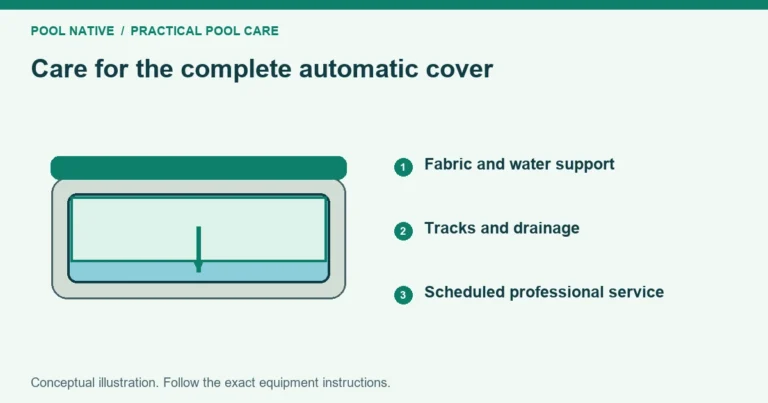
Check the pool’s required water level. Low water can increase drag and alter how the fabric is supported. An alignment adjustment does not correct that missing support.
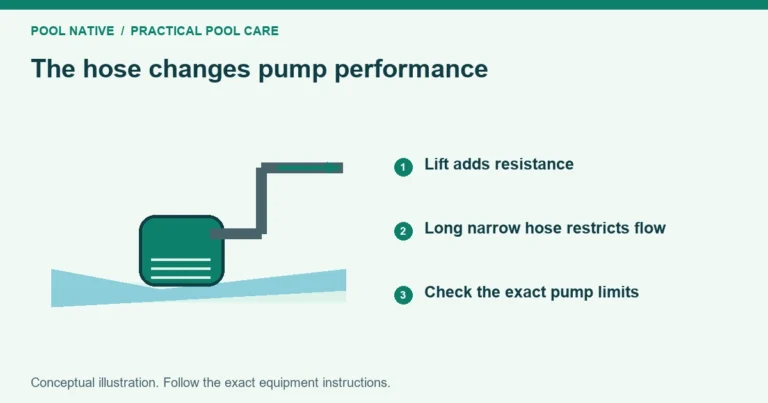
Confirm that the pump, hose and other removable equipment are clear before opening. Look for fabric contacting a step, rail or changed deck feature. Recent construction can introduce a new rubbing point.
Use debris removal or water support checks before further operation where relevant. Snow or ice requires the cover’s specific winter instructions. Do not force frozen fabric free with the motor.
Inspect the visible track path
With the system stopped and power isolated as directed, examine accessible areas from the deck. Look for leaves, grit, a damaged joint or an object pinching one side. Do not put fingers inside the track or drive mechanism.
Clean only as the manufacturer permits. Cover Pools’ T4 manual specifies water for track cleaning. Adding grease to make a resistant edge slide is not an equivalent repair.
Do not loosen track fasteners or file parts to make the cover pass. A raised fastener or misaligned joint needs proper correction. Removing material can change fit and damage protection.
If cleaning reveals a frayed rope, worn edge or damaged guide, stop the owner checks. Photograph it and request service. Do not test whether it can survive one more complete cycle.
Why rope adjustment is not a universal fix
The drive must coordinate movement on both sides while the fabric rolls and unrolls. Rope or cable condition, pulleys, guides, braking and fabric shape can all affect that coordination. A visible skew does not identify which part needs adjustment.
Correcting only one rope length can conceal unequal resistance temporarily. It may also change the opposite travel direction. The technician should inspect the cause before setting alignment.
Cover Pools directs owners with uneven retraction to a service company. Follow your own manufacturer’s repair process. Do not transfer a turn count or spool adjustment from another brand’s video.
When to stop all attempts
Stop if the leading edge twists sharply, leaves a track, catches on a structure or exposes damaged fabric. Grinding, repeated slipping or a protective stop are also reasons to avoid further operation. Keep the controller secured until assessed.
Do not defeat the torque limit to power through the problem. Do not have a helper push or pull while you operate the motor. Hands, clothing and tools must remain clear of moving components.
If closure is needed for access control, ask the installer about the exact emergency procedure. Manual movement can require disconnection and more than one trained person. It is not simply a matter of pulling harder on the lagging side.
Prepare for service and confirm the result
Record the cover model, direction, location where skew begins and any error indication. Add water level, recent storms and previous repairs. Include an overall picture and close views of visible wear without opening electrical equipment.
After repair, observe normal supervised travel in both directions. Confirm that the cover reaches its intended final positions without new hesitation. Ask the technician to explain any normal geometry specific unevenness and record it as the baseline.
Keep tracks and drainage on the maintenance schedule. If the same skew returns soon, report that history rather than repeating the adjustment yourself. Recurrence can reveal an unresolved source of drag or wear.