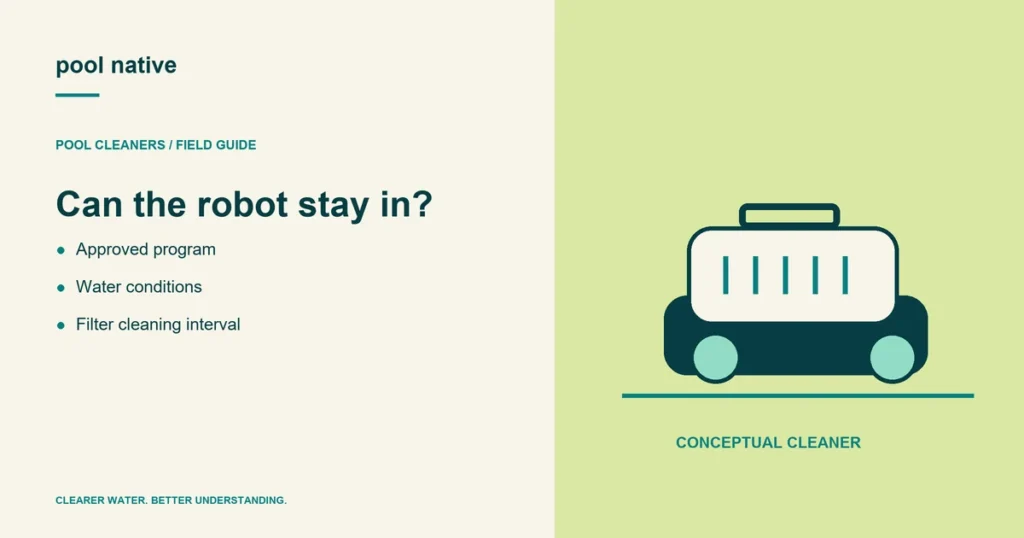
Usually, remove a robotic cleaner after its cycle so you can empty the filter and store the equipment properly. There are real exceptions: some models support a weekly timer or an extended Eco program in the water. Follow the instructions for the exact robot and mode.
Maytronics recommends routine removal after cleaning, while allowing certain weekly timer or Eco Mode Dolphins to remain in the pool for the weekly program. That does not mean every Dolphin, or every robotic cleaner, can live in the water indefinitely.
Check the program rather than guessing a safe duration
Find the manual’s instructions for the selected schedule, retrieval, filter cleaning, and water conditions. Confirm that your model supports the feature you intend to use. A timer on an external outlet does not create an approved weekly program.
A light debris load may fit the scheduled cleaning interval. Heavy leaves or fine sediment can fill the filter sooner. Inspect it often enough that the robot is not repeatedly running with loaded media.
Remove it before swimming and chemical treatment
Follow the manufacturer’s requirement to remove the robot before swimmers enter. The cable and cleaner can obstruct people in the water. A quiet or parked robot is still equipment occupying the pool.
Remove the cleaner before shock treatment or other chemical additions that require it. Wait until measured water conditions meet the robot’s operating limits before returning it. Do not substitute an arbitrary number of hours for a water test and the product instructions.
Normal pool sanitation and robot compatibility are separate checks. A robot’s maximum permitted chlorine level is an equipment limit, not a recommended sanitizer target for every pool.
The power supply has different exposure limits
A corded robot is made to work underwater; its power supply is not meant to sit in the pool. Keep the supply in the specified location, protected from standing water and unsuitable weather exposure. Follow its required pool distance and electrical protection.
Arrange the cable without creating a walking hazard or allowing a cover to pinch it. Check the instructions before combining a cleaning program with any pool cover. Permission to leave a robot submerged does not establish compatibility with the cover.
Make retrieval part of the routine
Stop the cleaner as directed and bring it within reach using its approved retrieval method. Lift it with the carrying handle rather than the floating cable. Drain, rinse, and clean the filter before storage.
Store the robot and supply in a dry, protected location according to the manual. Avoid tight cable bends and prolonged direct sun. A cordless unit also needs its own charging routine; use corded and cordless handling differences for that comparison.
Plan an unattended program around filter capacity
Before relying on an approved weekly schedule, observe the cleaner through ordinary local debris conditions. Check how much the filter holds after each cycle. A schedule that worked before leaf season may need more frequent attention once trees begin shedding.
If the basket is already heavily loaded after one cycle, leaving it for several more cycles is a poor maintenance plan. Arrange the required filter care or retrieve the robot. The timer controls when cleaning starts; it cannot empty the basket.
Write down who will retrieve the unit if swimming, chemical treatment, or unusual weather changes the plan. That person needs the model’s retrieval instructions and access to its controls. Do not rely on a remote status indicator to establish that the pool is ready for swimmers.
Separate short breaks from seasonal storage
Leaving a supported model between scheduled cycles is different from leaving it unused for weeks. When cleaning is no longer planned, use the storage instructions. Keeping equipment submerged does not replace draining, filter care, or battery preparation.
A winter cover introduces another question about access and compatibility. Check both sets of equipment instructions before closing the pool. A robot approved for a weekly cleaning program is not automatically approved to remain beneath every cover.
There is no single number of days that establishes acceptable storage for all robots. The model, operating mode, water conditions, and required maintenance determine the answer. If those details are unknown, routine retrieval after the cycle is the practical starting point.
When a longer stay stops making sense
Remove the cleaner if the filter needs attention, water conditions leave its permitted range, or the equipment behaves abnormally. Do the same when the pool will be unused for a long period and the manual calls for storage. An approved weekly program is not a winter storage method.
Use seasonal robot storage before closing the pool. If the cleaner has already stopped responding, follow movement and power checks rather than leaving it submerged and hoping the next schedule fixes it.