Pool maintenance gets easier when you know what you’re checking and what would make you change course. The goal isn’t to add something to the water every weekend. It’s to keep sanitation, circulation, cleaning, and equipment condition working together.
Start with the pool you actually own. Its surface, filter, sanitizer, plumbing, and local weather determine the useful routine. A checklist copied from a different setup can send you looking for a backwash valve that doesn’t exist.
Build your pool maintenance routine around four jobs
Think of pool care as four separate jobs with different triggers. None replaces the others. Clear water can still have inadequate sanitizer, and a healthy sanitizer reading won’t remove leaves.
| Job | What you’re trying to achieve | What tells you to act |
|---|---|---|
| Water care | Maintain the right sanitizer and balance for your system | Reliable test results and the applicable product instructions |
| Circulation and filtration | Move water through the equipment and capture suspended debris | Pump operation, flow, comparable filter pressure, and equipment alerts |
| Physical cleaning | Remove debris from surfaces and collection baskets | Leaves, sediment, buildup, and the condition of overlooked corners |
| Condition checks | Catch leaks, damage, and access problems | A visible change, an unusual sound, or a scheduled inspection |
Give each job an owner if more than one person helps. “Someone checked the pool” doesn’t tell you whether anyone tested the water. Write down the result and the next action.
Make a simple record of your equipment
Take readable photos of the pump, filter, heater, and sanitizer labels. Photograph the whole equipment pad too. Save the manuals with those photos rather than relying on an equipment brand alone.
- Pool: estimated water volume, surface material, and whether it shares water with a spa.
- Pump: exact model, programmed speeds or flow settings, and the normal schedule.
- Filter: exact model, media type, and the manual’s cleaning instructions.
- Sanitizer: product name or generator model, plus any stabilizer use.
- Other equipment: heater, cleaner, automatic cover, controller, and water features.
A salt chlorine generator makes sanitizer. It doesn’t replace the filter, and it doesn’t make testing optional. UV or ozone equipment also has its own role; don’t assume an installed device removes the need for a sanitizer residual.
If you inherited the pool, ask a qualified service technician to identify valve functions during a walk through. Don’t experiment with unfamiliar valve combinations while the pump runs. Label only the positions you’ve confirmed.
Use test results before choosing a treatment
Water appearance is an observation, not a chemical measurement. Test before adding a corrective product, then follow its label for dosing, circulation, and reentry. Keep the actual product concentration in your record.
For home pools, CDC recommends checking chlorine and pH at least twice daily, with more frequent checks during heavy use. Its chlorine minimum is higher when cyanuric acid is present. Those public health minimums don’t replace your system’s complete operating guidance.
Your water record should distinguish free chlorine from total chlorine. Also record pH, alkalinity, calcium hardness, and cyanuric acid when measured. Salt concentration belongs in the record when your equipment uses it.
Don’t mark an unmeasured value as zero. Don’t keep adding sanitizer because a suspicious result repeats without checking the test method. Expired reagents, incorrect sample handling, or a result beyond the test’s range can mislead you.
Use the instructions for the kit you’re holding. Take samples consistently and keep reagents within their storage requirements. A second trustworthy measurement is more useful than a stack of guesses.
Learn what normal circulation looks like
The circulation pump moves water through the system. The filter captures material from that moving water. Neither a louder pump nor a higher gauge reading automatically means better performance.
Record pressure only with the operating conditions attached. A reading at a low pump speed can’t fairly be compared with one during a fast cleaning cycle. Pool mode and spa mode may also produce different readings.
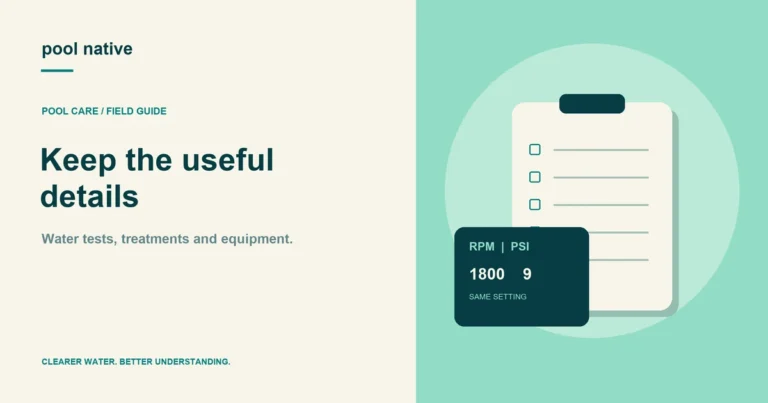
After confirmed filter service, record the clean pressure, pump speed or flow setting, and valve mode. Use the filter manual’s cleaning trigger. Our guide to deciding when a filter needs cleaning explains how to make those comparisons.
Watch for new bubbles, declining return flow, water leaks, or an unexpected change in sound. Record when the change began. “After the cleaner was connected” is a much better clue than “sometime this week.”
Remove debris before it becomes another problem
Skim floating leaves before they sink. Brush surfaces with equipment approved for the finish. Clean steps, benches, corners, and the waterline as needed; a cleaner may miss those areas.
Remove settled debris with a suitable manual or automatic cleaner. Empty its collection basket or bag according to its instructions. A robot’s full basket doesn’t tell you anything about the condition of the main filter.
Check skimmer baskets more often during leaf fall or storms. Shut the circulation system down as directed before reaching into collection points. Pump basket service also requires the model’s isolation and pressure release procedure.
Keep chemicals separate and in their original containers. Never mix products, combine old and new residues, or improvise a cleaning mixture. A familiar brand name doesn’t mean two formulations are interchangeable.
Separate routine work from work triggered by conditions
Your weekly maintenance checklist is a review session. It isn’t permission to ignore the pool between sessions. Water checks and urgent problems have their own timing.
| Situation | Useful response | What to avoid |
|---|---|---|
| Ordinary week | Review readings, clean surfaces, and compare equipment observations | Adding every product on a shopping list |
| Heavy use or hot weather | Check water more closely and respond to actual results | Assuming last week’s treatment still covers today’s demand |
| Storm or heavy debris | Inspect the pool, remove debris, and check equipment before normal use | Running blocked baskets or treating every storm identically |
| Opening or closing season | Use procedures for your climate and installed equipment | Borrowing a winter routine from a warmer region |
| Unexplained equipment change | Record the symptom and diagnose the affected system | Replacing media before identifying the cause |
Don’t schedule backwashing merely because it’s Saturday. Cartridge filters aren’t cleaned that way. Sand and DE filters have different service requirements, explained in the guide to filtration systems.
Keep a record you can actually use
A few consistent entries beat a beautiful notebook with gaps. Our downloadable pool operating log keeps readings, product additions, and equipment observations separate. It also leaves room for the next check.
Record a treatment when you make it, not from memory days later. Include the amount, units, product strength, and time. Keep the next test result on a new line so the sequence stays visible.
For equipment, log changes rather than just “OK.” Record the new pump schedule, a replaced cartridge, or a valve adjustment. Those entries help explain a later shift in pressure or water clarity.
Know when ordinary maintenance should stop
Keep swimmers out when the bottom isn’t clearly visible, a suction cover is damaged, or electrical equipment appears unsafe. A contamination incident needs its own response. Don’t treat it as an ordinary weekly adjustment.
A leaking filter closure, bulging tank, or uncertain pressure release is a service problem. Don’t tighten a pressurized closure or try to patch a tank. Arrange qualified help and follow the equipment shutdown instructions.
There is no need to learn every repair before you can care for a pool. Learn the normal condition, the useful measurements, and the points where you stop. That makes the routine manageable without turning guesswork into maintenance.