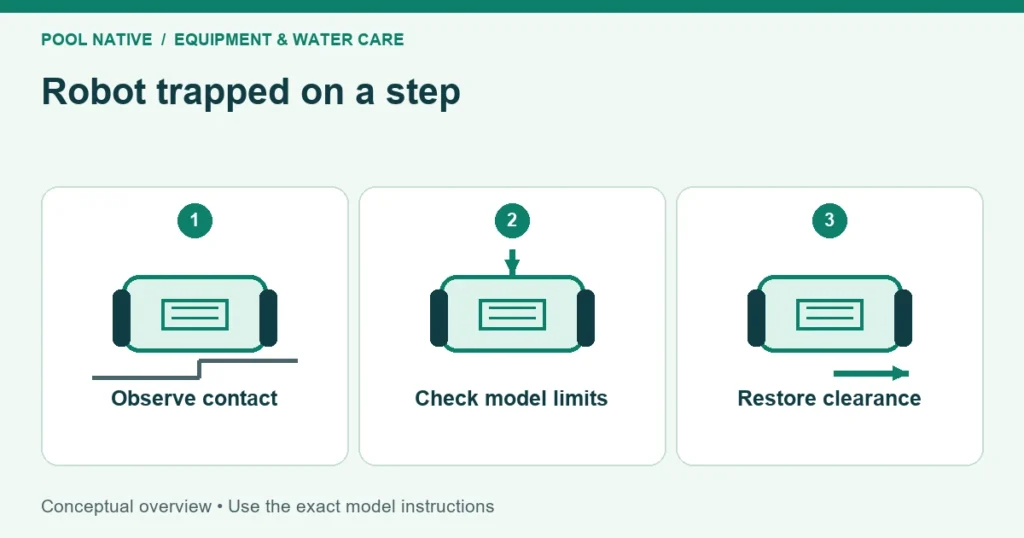
A pool robot stuck on steps needs a different fix depending on what actually traps it. The body may wedge beneath a tread, the tracks may lose contact, or the cable may hold it there. Watch the approach before buying a brush, float, or replacement cleaner.
A robot that turns away from a shallow ledge is not necessarily malfunctioning. Some models cannot clean that surface at all. Establish what yours is supposed to do, then investigate a repeatable failure within that capability.
Identify how the pool robot gets stuck on steps
Observe from the deck with swimmers out. Record the first approach and the moment forward movement stops. A short video showing the whole robot and nearby cable is more useful than a closeup after it is wedged.
| What you see | What the observation suggests | Useful next check |
|---|---|---|
| Body enters a gap but cannot turn | Clearance or geometry problem | Measure the gap and identify the contact points |
| Tracks rotate while the body rests on a step edge | Loss of useful contact | Note which wheels or tracks leave the surface |
| Cable becomes taut before the robot stops | Reach or cable routing restriction | Trace the cable back to its entry point |
| Robot falls onto the same side elsewhere too | A broader balance or drive issue | Review changed parts, filter condition, and visible wear |
| Robot approaches, reverses, and continues cleaning | Possibly normal obstacle handling | Check whether the missed surface is within its cleaning specification |
These observations choose an investigation; they do not prove a failed component. If the same robot also stalls in open water, use the broader cleaner fault guide. A problem confined to one narrow gap is less likely to be solved by changing every consumable.
Check the model’s actual step capability
Wall climbing does not automatically mean stair cleaning. A vertical wall gives the machine a continuous surface, while a tread interrupts that contact. A narrow landing also gives it less room to reposition.
Maytronics’ general support guidance excludes steps and ledges for the conventional robots it describes. Its LIBERTY 600 manual separately specifies step cleaning in particular modes. That newer capability cannot be assumed for an older Dolphin simply because the brand matches.
For the LIBERTY 600 example, Full Coverage and the shorter Eco schedules include step cleaning. The two week Eco schedule is floor only. Check the exact depth and mode provisions in its manual; a marketing picture is not a clearance specification.
Write down the full model and serial number, selected mode, and actual water depth above the troublesome tread. Distinguish the model’s general operating depth from any separate shallow ledge allowance. If the documents appear inconsistent, ask support about that specific installation before trying repeated runs there.
Separate a cable problem from a clearance problem
On a corded machine, look for cable wrapped around a ladder leg or pulled tight across a corner. Start with the documented power supply location and cable arrangement. Keep the required electrical setback even if moving the supply closer would improve reach.
Enough cable must reach the working area without loading the robot sideways. Excess cable can create another obstacle. The Dolphin cable tangle guide explains how to reset the arrangement and check whether repeated circling is creating the twists.
A cordless robot removes that cable variable, but it does not change the width of a gap. Replacing a corded machine with a similarly sized cordless one may leave the same physical trap. Compare body dimensions, turning space, and documented obstacle behavior before treating cordless power as the solution.
Restore normal traction and balance first
Switch the cleaner off using its own inspection procedure before touching moving parts. Empty and clean the filter, then check that it seats correctly. Look for a displaced track, torn brush, or visible object caught near a wheel.
Pay attention to the history. A problem that began after replacing a cable, brush, or filter deserves a fit check on that part. Similar looking floats or climbing components can differ between models.
Do not remove factory foam because it resembles packing material. Do not add weights to hold the robot down. Both changes can alter the machine’s intended balance and hide the reason it cannot recover.
If the robot struggles to settle before reaching the steps, follow the floating robot checks first. If it travels normally but leaves dirt on reachable floor, that belongs in missed floor coverage diagnosis. Those problems can coexist, but they need separate observations.
Use an approved remedy for the actual obstacle
Ask the cleaner manufacturer whether it offers an approved accessory or setting for your model and obstacle. Supply photos and measurements rather than just saying it gets stuck. Confirm the accessory’s part number and whether it affects another pool component.
Avoid improvised ropes, mesh, ramps, or barriers around ladders and steps. They can create new snags or interfere with access. Removing an access feature is not an ordinary robot adjustment; any change must preserve the pool’s required safe entry and exit arrangements.
Never alter a suction outlet or its cover to help a cleaner cross it. A robot caught on a drain is a different problem, covered in drain trapping checks. A device sold for one obstacle is not automatically appropriate for another.
Judge the fix through a complete cleaning cycle
Consider an illustrative test: the cleaner catches under the same ladder tread three times, but runs freely elsewhere. After an approved cable routing change, it passes the ladder and completes its cycle. That points toward the cable arrangement rather than a general drive failure.
If it still catches at the same body contact point with a relaxed cable, record that result too. It argues for a geometry or model fit discussion. Changing another unrelated setting would make the result harder to interpret.
One successful pass is encouraging, but check the complete cycle and final cleaning result. The robot should escape the feature without repeatedly sacrificing most of its runtime there. Keep the setting that works only if it also meets the manufacturer’s operating requirements.
Some inaccessible steps will still need manual attention. Brush them with a finish compatible tool and remove the displaced debris through an appropriate cleaning method. A robot can remain useful even when it cannot take over every surface in the pool.