Choose a sand filter if you want routine cleaning without measuring and replacing filter powder. Choose a DE filter if finer particle capture matters enough to justify that extra handling and element maintenance. Either choice still needs suitable sizing, a workable waste outlet, and consistent water chemistry.
The useful comparison is the maintenance job you’ll actually do. A filter that’s awkward to clean or impossible to discharge legally is a poor fit, regardless of its clarity claims. Compare the proposed models and installation before deciding on the filter type.
What changes when water passes through the filter?
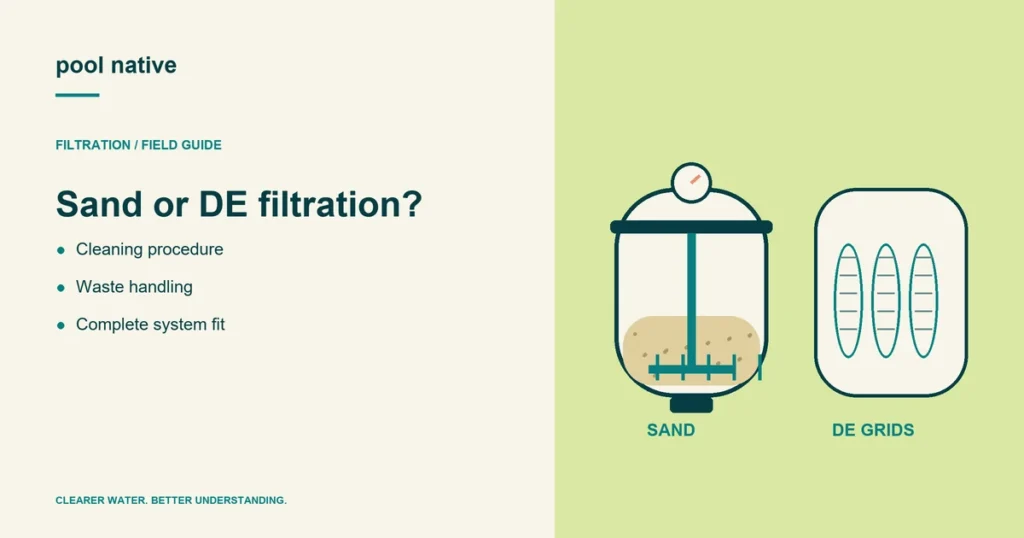
A sand filter traps debris as water passes through its media bed. A conventional DE filter uses a coating of diatomaceous earth on supported fabric elements. That coating generally captures finer particles than standard pool filter sand.
Neither process replaces a sanitizer. A pool can look clear while its chlorine is inadequate, and changing filters won’t correct an ongoing chemistry problem. Keep water testing separate from judging appearance.
| Ownership question | Sand | Conventional DE |
|---|---|---|
| Routine cleaning | Backwash and rinse as the model requires | Backwash or clean, then restore the required DE coating |
| Media after cleaning | The sand normally remains in the tank | Removed DE needs replacing according to the manual |
| Fine particle capture | Generally coarser with standard sand | Generally finer with the correct coating |
| Additional service | Media condition, valve, and internal parts | Elements, manifold, seals, and coating quality |
| Waste planning | Backwash water needs an approved destination | Water and spent DE need suitable disposal |
This comparison concerns ordinary sand and conventional DE filters. Alternative media and regenerative DE designs can change the cleaning process. Ask for the exact manual rather than treating every product in a category as identical.
Walk through one cleaning before buying
Ask the installer to show where you’ll stand, where water will go, and what you’ll need to lift. A demonstration can reveal a cramped valve handle or lid that cannot clear nearby plumbing. Those inconveniences recur every time the equipment needs attention.
With a typical sand setup, the routine job uses the valve to reverse flow and then resettle the bed. It doesn’t involve replacing a charge of sand afterward. Sand returning to the pool calls for troubleshooting rather than routine topping up.
With conventional DE, include measuring the approved filter powder and restoring the coating in your assessment. Keep powder handling consistent with its label and safety instructions. Don’t assume a kitchen scoop equals the weight specified for the filter.
Backwashing also doesn’t eliminate every need to open and inspect a DE filter. Ask who will clean the elements and check their condition when necessary. If you plan to hire that work out, get its price before choosing.
Filter service involves pressurized equipment. Shut off the pump and automatic controls and follow the manual’s pressure relief procedure before opening anything. Change valve positions only with the pump off, then use the specified restart procedure.
Don’t compare cleaning frequency by calendar alone
A large filter on a lightly used pool and a small filter beneath shedding trees face different loads. Neither “weekly backwash” nor “once a season” is a dependable promise for your yard. Cleaning intervals also change during a major debris cleanup.
Record clean filter pressure at the normal operating pump speed. Use the model’s cleaning trigger and watch flow as directed. Comparing readings at different pump speeds can make an ordinary speed change look like accumulating dirt.
Repeatedly short runs deserve investigation before you buy a replacement. Check whether the filter was properly cleaned and whether debris is still entering the water. Use the high filter pressure guide when pressure remains abnormal.
Check the waste route before the equipment price
Both conventional systems can discharge pool water during cleaning. DE also introduces spent filter powder into that waste stream. A hose reaching the street doesn’t establish permission to use the storm drain.
Ask your local wastewater or stormwater authority about pool filter waste specifically. Rules for dechlorinated pool water may differ from rules for dirty backwash or salt water. Confirm any required solids collection and the permitted connection.
Water use depends on the actual cleaning flow, duration, and frequency. Ask the installer to estimate all three instead of quoting a universal gallons per backwash figure. Include replacement water in your ownership comparison.
If the property has no practical approved discharge route, pause the purchase. Discuss other filtration arrangements with the installer and the local authority. Don’t commit to either option on the assumption that waste disposal can be solved later.
Compare complete quotes, including the work around the tank
A bare filter price leaves out costs that can change the decision. Request the same scope from each installer so the comparison is useful. Separate recurring service from the initial installation.
- Filter, compatible valve, initial media, and required fittings.
- Plumbing changes, base, access clearance, and old equipment removal.
- Approved waste connection or solids handling equipment.
- Expected cleaning labor and consumables for your pool’s conditions.
- Prices and availability for the relevant internal replacement parts.
For DE, ask how many replenishments the estimate assumes and what each uses. For sand, ask what would justify media service or replacement rather than accepting an automatic annual charge. Get assumptions in writing so a cheap estimate doesn’t conceal a different maintenance plan.
Pool gallons alone aren’t enough to select either filter. The proposed unit must suit the circulation system’s flow and its own cleaning requirements. Tank diameter and DE element area aren’t interchangeable sizing numbers.
Which choice fits your priority?
Sand is a reasonable preference when you value a straightforward valve based cleaning routine and don’t want recurring powder handling. Check that the proposed filter has appropriate capacity and an accessible waste route. Standard sand can serve a clear, well maintained pool without pretending to match every fine filtration claim.
DE is a reasonable preference when fine capture is a priority and you’ll consistently perform or pay for its complete cleaning process. Confirm element access, powder handling, and waste arrangements. A finer filter won’t compensate for neglected sanitizing or a damaged internal assembly.
If you’re replacing equipment because the water stays cloudy, identify the cause first. The cloudy water guide separates chemistry and circulation issues from filtering problems. A working diagnosis makes the purchase decision more useful than choosing whichever category sounds more powerful.