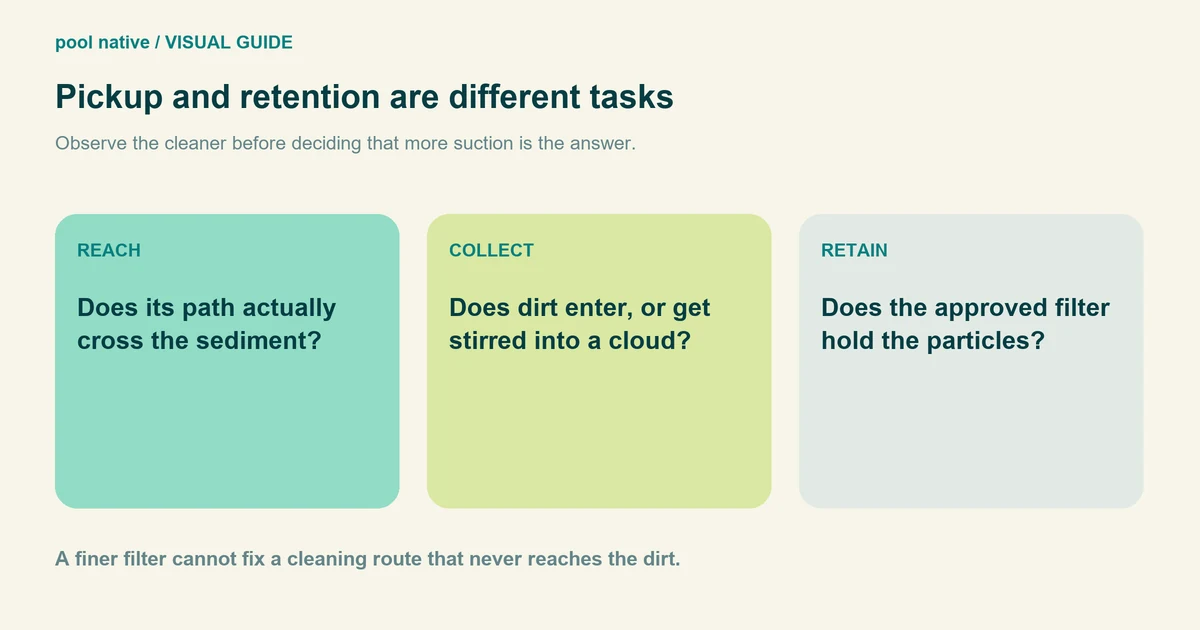
A cleaner can lift fine sand from the floor and still leave the pool looking dusty. The missing step is retention: the filter must hold the particles after the intake collects them. Choose a cleaner by its compatible fine debris media, not by a claim of powerful suction alone.
Before replacing an existing robot, identify its installed filter and check for damage or gaps. A compatible finer filter may solve the problem. It will not help if the cleaner never reaches the sediment.
Identify where the dirt goes
Watch a small patch from the deck during a normal cleaning cycle. Note whether the robot misses it, blows it into a cloud, or removes it temporarily. Compare that observation with the debris you find in the filter afterward.
| What you observe | What to investigate | What buying a finer filter cannot fix |
|---|---|---|
| The cleaner never crosses the patch | Coverage, reach, obstacles, and cycle choice | A route that never reaches the dirt |
| Dirt enters, then appears behind the cleaner | Media suitability, seating, damage, and collection flaps | A damaged intake or incorrectly assembled basket |
| A cloud forms before collection | Brush disturbance and slowly settling sediment | Suspended material outside the cleaner’s path |
| Filter fills quickly with fine material | More frequent rinsing and staged cleanup | A large debris load in one uninterrupted cycle |
Fine sand, dead algae, and treatment residue can look similar underwater. A robot does not diagnose the material or sanitize the pool. If the residue followed flocculant treatment, check the product’s removal instructions and our guide to vacuuming settled floc.
Ask for the exact filter, not a marketing label
Fine, ultrafine, and similar names are not interchangeable standards across manufacturers. Ask which filter part number fits the cleaner and whether it is included. If a seller quotes a micron rating, look for manufacturer documentation that identifies the same filter.
Maytronics’ S200 parts listing, for example, distinguishes fine panels from ultrafine panels and other filter assemblies. That is a useful compatibility example, not a guarantee that every S200 package includes the same media. Verify the robot’s model, market, and serial number before ordering.
Do not add improvised cloth, powder, or restrictive material to a robot basket. A modification can affect water movement and may interfere with the pump. Use the collection system the manufacturer approves.
Choose the collection path that fits your pool
A robot with suitable fine media keeps collected sediment in its own filter. That makes inspection straightforward, but fine loading can mean frequent rinsing. See how to clean a robot filter before deciding whether that routine suits you.
A suction cleaner sends material toward the main filtration system. Its ability to collect fine dirt depends partly on what that system retains. A coarse pressure cleaner bag may suit leaves much better than very fine silt.
A manual vacuum can be useful for slow, deliberate passes over a localized deposit. Where the plumbing and disposal rules allow it, an appropriate waste path avoids recirculating collected material. That option uses water and requires watching the pool level; it is not available on every filter installation.
Distinguish retained dirt from dirt that arrives again
Inspect the cleaned area soon after a cycle and again later under ordinary conditions. If it is clear immediately but dusty the next day, consider new material entering the pool or sediment settling from the water. That pattern is different from dirt visibly leaving the robot as it passes.
Check nearby soil, wind exposure, runoff, and the timing of recent work around the pool. If grit appears mainly near the returns, investigate the filtration system too. Use sand returning to the pool when filter media is a possibility.
Do not call every brown or gray deposit sand. Appearance alone cannot distinguish fine mineral particles, organic debris, and treatment residue reliably. Keep the recent water treatment and weather history with your observations.
Compare candidates with a short evidence checklist
For each cleaner, write down the exact model, supplied filter, approved finer filter options, and supported pool geometry. Ask for the manufacturer part number of any optional media. “Fine filter available” is incomplete if nobody can confirm the part that fits the offered version.
Next, inspect the filter’s access and cleaning method. A very fine medium may need more frequent attention when the load is high. The useful question is whether you can maintain it during the cleanup, not whether the marketing description sounds more precise.
Then check collection bypass points described in the manual, such as panel seating and intake flaps. Damaged or incorrectly assembled parts can let dirt escape around otherwise suitable media. A finer mesh cannot close a gap beside the filter.
Finally, review the seller’s actual return and warranty terms. Confirm the exact product and included accessories on the order. Similar names and shared review listings can conceal a different filter package.
Use staged cleanup for a mixed debris load
Remove substantial leaves and loose objects before asking a fine filter to handle the final sediment. If the manufacturer supplies different media for different loads, follow its sequence and compatibility instructions. Do not improvise a restrictive liner inside the basket.
Check the filter early during the first pass. If it loads rapidly, empty and rinse it as directed before continuing. A full cleaning cycle on the timer is not a requirement to keep operating with a loaded collection system.
For a small localized patch, a slow manual pass can provide more control over disturbance. For persistent suspended cloudiness, address the water and main filtration problem separately. A robot that crosses the floor cannot capture every particle floating elsewhere in the pool.
Check the pool shape and the usable price
List the places sediment collects: the deep floor, a narrow corner, a slope, or a shallow shelf. Confirm the candidate’s minimum operating depth and coverage there. A robot advertised for walls can still leave a shelf outside its operating depth.
Compare the price with the required fine filter included, plus replacement media and service access. Ask whether the seller’s return terms allow you to assess performance in your pool. We have not performed a controlled pickup test on these cleaners, so a numbered ranking would imply evidence we do not have.
If you already own a working robot, start with correct assembly and approved filter options. If you are choosing a new system, use robotic versus suction cleaning to compare the whole collection path. The useful purchase is the one that both reaches your sediment and retains it.