A robotic cleaner carries its own motor and filter. A suction cleaner uses the pool pump to move. It sends collected debris toward the pool’s filtration system.
That difference affects your cleaning schedule, basket emptying, and equipment costs more than the number of features on the box.
Choose a robot when you want cleaning that operates independently of the circulation pump. A suction cleaner can suit an existing compatible vacuum connection and a pump schedule that supplies its required flow. Neither type replaces brushing, water testing, or sanitation.
Follow the debris to see the difference
| Question | Robotic cleaner | Suction cleaner |
|---|---|---|
| What powers it? | An approved electrical supply or onboard battery | Water drawn by the pool pump |
| Where does dirt collect? | Inside the robot’s basket, bag, or cartridges | Along the suction collection path, including baskets and the main filter |
| What needs regular attention? | Filter media, brushes, tracks, cable or battery | Hose, moving cleaner parts, baskets, regulator, and pool filter |
| What limits coverage? | Model capability, reach, pool geometry, and cycle selection | Hose reach, available flow, adjustment, and pool geometry |
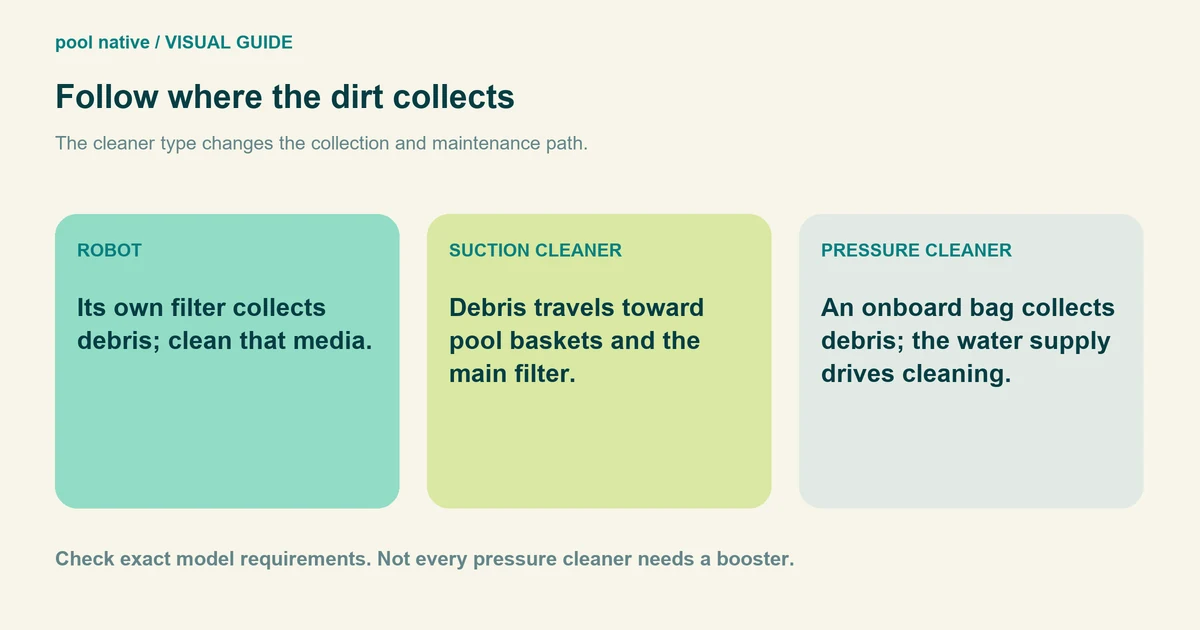
A robot can remove debris without adding that collected dirt to your main filter. You still have to lift it out and clean its filter. A suction cleaner may reduce that lifting task, but its dirt must be removed elsewhere in the system.
Check the pool before choosing features
Confirm the cleaner’s approval for your pool surface, dimensions, depth, and slopes. Wall cleaning is a model feature, not a promise attached to every robot. Steps, benches, sharp transitions, and drain covers can remain awkward for either system.
Look at your usual debris, too. A large leaf can block a narrow intake, while fine sediment may pass through unsuitable filter media. Our guides to cleaners for fine sand and heavy leaf cleanup separate those jobs.
For suction cleaning, identify the intended connection and the manufacturer’s required flow check. Do not assume that an existing skimmer or a high horsepower label proves compatibility. The cleaner must work without causing persistent air entry or loss of pump prime.
Compare the cost of a usable setup
Ask for the total installed cost, including any connection parts, suitable filter media, and necessary accessories. Then compare replacement filters, hoses, brushes, tracks, and service access. A low purchase price can lose its appeal if routine parts are difficult to obtain.
For electricity, compare the actual operating schedules. A robot consumes power itself; a suction cleaner may require a higher circulation pump speed than your normal filtration setting. Without those figures, a universal savings percentage would be guesswork.
Which choice fits three common situations?
A small circulation system that already struggles with vacuuming: investigate the weak supply first. A robot can collect dirt independently, but it does not fix the pool’s circulation problem. Buying one should not become a way to ignore inadequate filtration or a priming fault.
A pool with a reliable existing suction cleaner: compare the cost of maintaining it with the specific benefit a robot would add. Separate onboard filtration, easier fine media changes, or independent scheduling may be useful. A newer cleaner is not automatically a better fit for the same job.
A pool receiving heavy seasonal debris: assess intake clearance and collection capacity before choosing a supply type. Either system can need frequent attention during a large cleanup. Removing the bulk first can be more practical than expecting any automatic cleaner to swallow everything in one cycle.
Build an ownership comparison with real inputs
For the robot, include the unit, any required fine filter, a suitable storage arrangement, and expected replacement wear parts. Check where warranty and later repairs are handled. If shipping is required, ask how the owner returns a wet, bulky unit safely.
For suction cleaning, include the correct hose length, connection parts, regulator, and any approved leaf canister. Consider whether the pump must run at a different setting for cleaning. The cost comparison needs the actual schedule, not just the cleaner’s purchase price.
A robot’s separate filter can also make the debris visible when you empty it. A suction cleaner may place the same material in several parts of the pool system. Think through which maintenance routine is easier for you to repeat consistently.
Ask about the difficult parts of your pool
Give the seller the floor shape, depth range, surface, and obstacle details. A maximum pool length does not establish performance on a tanning ledge or around a raised drain. Ask specifically about the areas your current cleaner misses.
Check whether the model cleans only the floor or also includes walls and the waterline. Those tasks should appear in its specifications. Brushing a wall and collecting floor debris are different capabilities.
Finally, consider handling at the pool edge. A robot must be retrieved and carried for filter care, while suction equipment involves a hose and connection routine. The easiest system is the one whose actual maintenance fits your access, strength, and available storage.
Choose the routine you will maintain
A robot makes sense when separate debris collection and independent scheduling solve a real problem. Before buying, consider whether you can comfortably retrieve the unit and rinse its filter after use. Cord handling and charging are separate decisions covered in corded versus cordless robots.
A suction cleaner makes sense when the pool already supports it and you prefer maintaining hoses and baskets. If your existing cleaner worked well before slowing down, use suction cleaner troubleshooting first. A blocked hose or dirty basket does not automatically justify replacing the whole system.