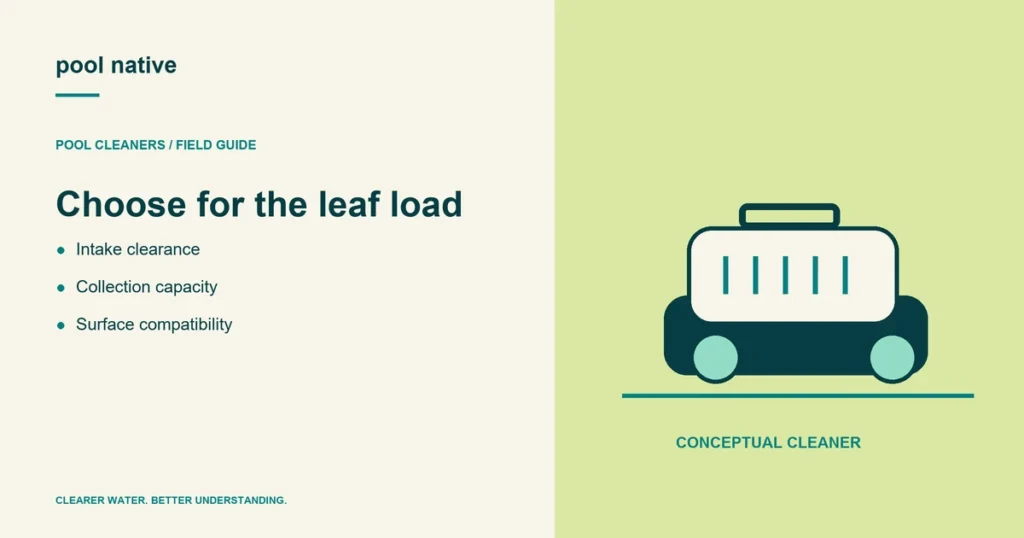
A pool full of leaves needs room in both the cleaner’s intake and its collection bag. A powerful motor cannot pull an oversized leaf through a narrow opening. For a heavy load, start by removing the bulk with a leaf rake, then choose a cleaner for what remains.
The right tool also depends on whether this is a storm cleanup or a daily problem. A manual leaf vacuum can suit occasional piles. A compatible automatic cleaner can reduce repeated work during a long leaf season.
Separate floating leaves from sunken leaves
A floor cleaner does not replace surface skimming. Collect floating leaves before they become waterlogged when practical. That reduces the material the floor cleaner has to handle later.
For leaves already on the bottom, check their size and condition. Whole leaves, long needles, acorns, and soft decomposing debris can challenge different parts of a cleaner. A large collection bag does not prove that the intake can pass every object.
Compare three useful cleanup approaches
| Approach | Where it can fit | Main limitation |
|---|---|---|
| Leaf rake followed by manual cleanup | Occasional piles and targeted removal | Requires your time and suitable reach |
| Garden hose leaf vacuum | Large loose leaves on an approved surface | Adds water and depends on hose supply and bag retention |
| Automatic cleaner with suitable collection capacity | Recurring debris across the pool floor | Can fill before the cycle ends; installation and coverage still matter |
Pressure cleaners often have onboard bags, but their supply requirements differ. For example, a Polaris 280 needs a booster pump. Do not buy a pressure cleaner until you have checked the pressure versus suction installation requirements.
A robot also keeps collected leaves in its own filter. Check how easily you can open, empty, and reseat that filter. During heavy leaf fall, an accessible basket may matter more than remote control features.
A garden hose option, with important limits
The Poolmaster 28300 Big Sucker uses garden hose water and a collection bag to lift leaves. Its manufacturer lists a 15 inch body and eight water jets. It requires a suitable pole and hose, which are separate items.
This is a manual leaf tool, not a replacement for fine sediment filtration. Its included general leaf bag should not be treated as proof of fine silt capture. See choosing a cleaner for fine sand if that is the actual problem.
There is also a surface question to resolve before buying. Poolmaster’s product page describes use in all pools, while its 2026 catalog specifies hard surfaces. Because those descriptions differ, confirm suitability directly for a vinyl liner or other delicate finish.
Our saved owner review sample included praise for leaf removal and complaints about bag attachment and spilling during retrieval. That is a small, nonrandom sample, not a failure rate or a performance test. If this tool fits your surface, bag fastening and controlled lifting deserve attention.
As an Amazon Associate, Pool Native earns from qualifying purchases.
Once you have confirmed that it suits your pool finish, view the Poolmaster 28300 Big Sucker on Amazon. Check the included bag and required pole and hose before ordering. Keep the surface compatibility question above in mind for vinyl or delicate finishes.
Judge capacity by a real cleaning interval
Instead of asking whether a basket looks large, ask how often your leaf load will fill it. Check it early during the first cleanup. A heavy bag can affect movement, and packed debris can reduce water flow.
Do not force hard objects through an intake or keep running a cleaner that repeatedly jams. Remove toys, substantial sticks, and other obvious obstructions first. Follow the model’s instructions before clearing anything from the cleaner.
Check retrieval as carefully as pickup
A tool may collect leaves well and still spill them when lifted incorrectly. Read the bag attachment and retrieval instructions before the first heavy cleanup. Keep the load manageable rather than waiting until the bag is packed and difficult to handle.
For a garden hose leaf vacuum, identify how water pressure and the bag opening work during removal. Follow the tool’s instructions instead of applying a robot’s retrieval method. Keep the pole and hose under control from the deck.
For a robot or pressure cleaner, empty the collection assembly where spilled leaves cannot immediately wash back into the pool. Inspect clips, zippers, or collars for damage. A worn closure can undermine a bag that otherwise has enough capacity.
Account for the water added by a hose powered tool
A garden hose leaf vacuum introduces fresh water while it operates. Watch the pool level and stop before creating an overflow problem. The tool’s cleaning time therefore has a water use consequence as well as a labor cost.
Check whether the hose reaches comfortably and can supply the tool under the manufacturer’s conditions. A distant hose connection and awkward pole reach can make a manual option less convenient than it appears in a close product photograph. Include the actual pool access in the decision.
A hose powered leaf tool does not require the same connection as a suction vacuum using the pool pump. Keep those methods distinct when buying accessories. The manual suction vacuum setup follows a different water path.
Choose capacity for your ordinary season, then plan exceptions
If a few leaves fall every day, an automatic cleaner with manageable emptying may suit the routine. If one major storm produces the year’s worst pile, bulk manual removal may handle that exception better. Buying for the largest imagined load can add cost without improving the task you repeat.
For persistent heavy leaf fall, compare the time spent emptying and clearing the candidate, not just its nominal cycle duration. Ask about replacement bag availability and the attachment parts that wear. A cleaner is only useful while you can keep its collection system intact.
Keep fine silt cleanup as a separate requirement if it follows the leaf removal. A large leaf opening and coarse bag solve a different part of the job. You may need a finishing pass with suitable media rather than one tool doing both tasks equally well.
Choose for the job you repeat
For one heavy cleanup, removing the bulk manually can avoid buying an automatic cleaner for an unusual event. For recurring leaves, compare intake clearance, accessible collection capacity, pool coverage, and replacement bag availability. Include any pump or plumbing work in the total cost.
If your existing robot has become slow as the leaf load rises, start with filter cleaning. If a pressure cleaner struggles even with an empty bag, use the pressure cleaner movement checks. A maintenance problem and a capacity problem need different answers.