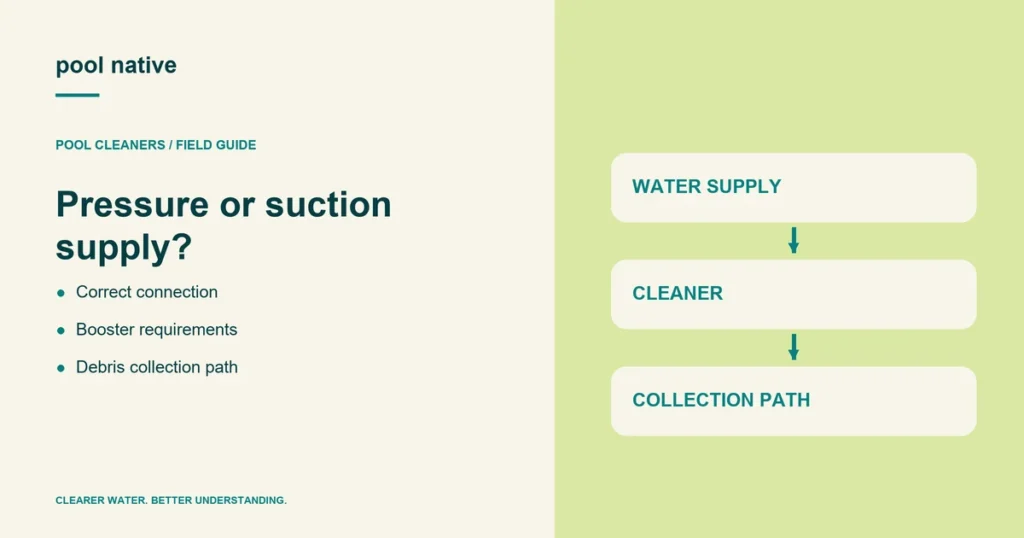
Pressure and suction pool cleaners both use moving pool water, but they connect to opposite sides of the circulation system. A suction cleaner draws water toward the pump. A pressure cleaner receives water from a return supply and usually collects larger debris in its own bag.
The first buying question is whether your pool has the right connection and water supply. An unused fitting in the wall is not enough to identify either one. Have unfamiliar plumbing traced before ordering a cleaner.
Pressure cleaners do not all need a booster pump
The Polaris 280 requires a compatible booster pump. The Polaris 360 is designed to operate without one. Those two verified examples show why advice about all pressure cleaners needing an extra pump is misleading.
A boosterless cleaner still needs adequate water delivery from the pool system. It is not independent of pump speed or plumbing conditions. Adding a cleaner to an unsuitable return line can require installation work beyond buying a hose adapter.
| Installation question | Suction cleaner | Pressure cleaner |
|---|---|---|
| Which supply? | Approved suction connection | Approved pressure connection |
| Extra pump? | Uses circulation pump suction | Depends on the exact cleaner |
| Debris handling? | Collection path includes pool baskets and filter | Onboard bag collects debris; some fine material may remain for filtration |
| Setup check? | Manufacturer’s flow gauge or specified movement test | Manufacturer’s flow or wheel speed procedure |
Match the cleaner to the debris
Pressure cleaners with a suitable intake and bag can be useful for recurring leaves. Bag capacity still limits how long they clean effectively. A heavy or overloaded bag can change how the cleaner travels.
A suction cleaner moves collected material toward the pool equipment. Large leaves may obstruct the cleaner or hose before they reach a basket. An approved leaf canister can help in some installations, but compatibility and regular emptying still matter.
For dust and silt, inspect the actual collection media rather than choosing by supply type. A coarse bag is not a fine particle filter. See fine sand cleaner selection for the distinction between picking dirt up and keeping it captured.
Include pump operation in the comparison
Compare the circulation schedule each option needs, plus booster operation where applicable. Existing plumbing may make one system much simpler to install. A full installation quote should identify the cleaner, supply arrangement, controls, and required operating conditions.
Do not shorten filtration solely because a cleaner finishes a cycle. Pool circulation also supports filtration, heating, and sanitation equipment. Cleaning the floor is only one task in that system.
Changing cleaner type can be a plumbing project
If the pool already has a dedicated pressure supply, replacing a compatible pressure cleaner may be relatively straightforward. Converting it to suction cleaning is a different question. The fitting and pipe route must support the new function, not merely accept an adapter.
Similarly, an existing suction connection does not become a pressure supply by attaching a different hose. Have the installation traced and any changes designed by the pool professional. Avoid experimenting with an unfamiliar wall opening while the pump runs.
Ask the quote to separate the cleaner price from required plumbing, booster equipment, and controls. Include removal or correct isolation of redundant equipment where applicable. That prevents a low cleaner price from hiding the real conversion cost.
Compare what happens during a dirty cycle
With a pressure cleaner, inspect how easily its bag detaches and empties. A large leaf load may fill it long before the nominal cycle finishes. The bag’s debris type and condition influence what stays captured.
With a suction cleaner, inspect the entire collection route. Leaves may reach a canister, skimmer basket, pump basket, or filter depending on the approved arrangement. A blockage can occur before the dirt reaches the main filter.
Neither system removes the need to check flow as debris accumulates. Correct initial adjustment is not proof that a loaded cleaner still operates correctly. Build early checks into the first few cycles under your normal leaf load.
Three questions that can settle the choice
First, which system does the existing plumbing support without unnecessary conversion? Second, which collection arrangement fits the actual debris? Third, which maintenance and pump schedule will you reliably manage?
If pressure cleaning wins because the pool already supports it, verify the exact booster requirement rather than assuming all pressure models match. If suction wins, verify the flow test and approved connection. If both require substantial modifications, compare a robot before committing to the plumbing work.
Ask the installer to document the final operating settings and demonstrate the normal setup. A cleaner should not depend on an unexplained valve position that nobody can restore after filter service.
Know what you will be maintaining
Suction systems need attention to hoses, regulators, baskets, and the cleaner’s moving mechanism. Pressure systems add bag condition, feed hose leaks, swivels, and any backup mechanism. Part names and adjustment values vary across models.
If you already own a cleaner, distinguish a supply fault from worn parts before switching systems. Start with slow suction cleaner checks or pressure cleaner movement problems.
For a new purchase, choose the system your pool can support and whose maintenance you can manage. If you want a cleaner with separate power and filtration, compare robotic and suction cleaners before modifying the plumbing.