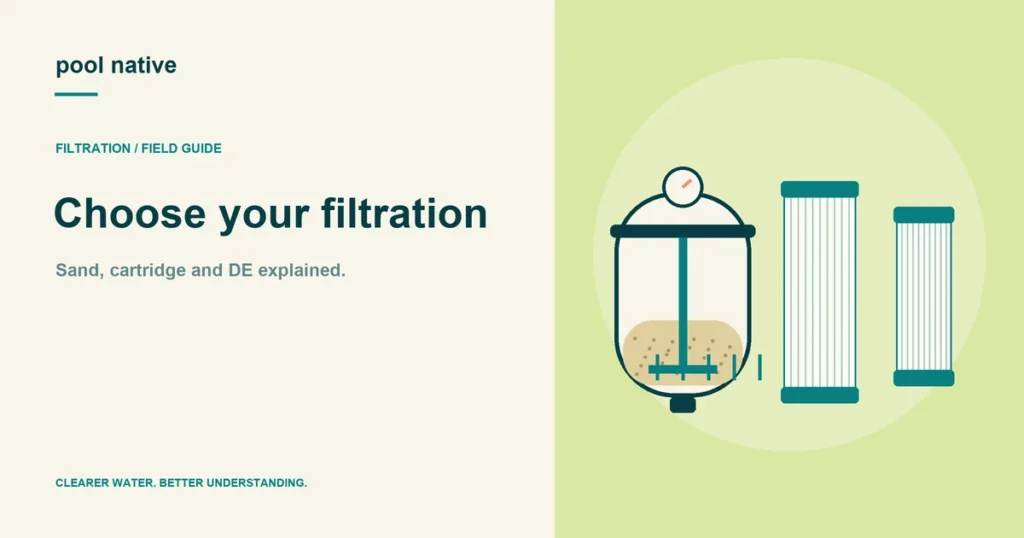
Your pool filter should suit the water flow, the space around the equipment, and the maintenance you’re willing to do. Sand, cartridge, and DE systems can all work well. The useful choice is the one you can size, service, and operate properly.
Start by separating filtration from sanitation. A filter captures suspended material. Sanitizer controls susceptible organisms in the water; clear water alone doesn’t prove that job is being done.
What a pool filter does in the circulation system
The pump moves water from the pool through the equipment. The filter places a material in that path to capture particles. Water then returns to the pool through the rest of the installed system.
A skimmer basket catches larger debris before it reaches the pump. The pump basket provides another collection point. Neither basket replaces the finer filtering work inside the tank.
A robotic cleaner is different again. Many robots collect debris in their own basket, separate from the main filter. Emptying that basket doesn’t clean the equipment pad’s filter.
Saltwater pools still need a filter. Their chlorine generator makes sanitizer from salt in the water. Sand, cartridge, and DE describe filtration choices, not competing alternatives to salt sanitation.
Compare the work each filter asks of you
| Filter type | What captures debris | Routine cleaning | Constraint to check first |
|---|---|---|---|
| Sand | A bed of approved granular media | Backwashing through the correct valve sequence | Suitable waste discharge and adequate backwash flow |
| Cartridge | Pleated elements | Removing and cleaning the elements | Safe access, lifting clearance, and a suitable wash area |
| DE | A coating of diatomaceous earth supported by grids or elements | Model specific backwashing or other service, with required media replacement | Media handling, disposal, and more involved internal service |
Don’t choose from a micron chart alone. Published particle claims can use different conditions and don’t describe the entire pool system. Flow, fit, intact media, water care, and maintenance all matter.
Sand: convenient routine valve operation
A sand filter sends water through a bed of specified media. Backwashing reverses the cleaning flow and carries collected debris to waste. The valve arrangement determines the exact sequence.
This can suit an owner who prefers occasional valve operation to lifting cartridges. But the system needs somewhere appropriate to send wastewater. It also needs the flow required to clean the bed properly.
Media replacement is a separate, more involved job. Access to the tank and its internal piping matters. Our explanation of the water path inside a sand filter makes those parts easier to understand.
Cartridge: no routine backwash cycle
A standard cartridge filter is cleaned by removing its elements. A hose rinses debris from between the pleats. Compatible cleaning treatment may be needed for deposits that water alone won’t remove.
It avoids the usual backwash discharge, but cleaning still uses water. You need enough room to remove the lid and lift the elements. A low roof over the equipment can make a seemingly good choice awkward to service.
Some tanks contain one cartridge; others hold a set. Replacement cost and handling depend on that design. The housing model matters more than a cartridge’s color or the apparent size of the tank.
DE: filtration with a replaceable coating
DE filters use a coating of fine filter media supported by internal elements. The fabric supports that coating rather than doing exactly the same job as a standard cartridge.
Servicing can involve backwashing, disassembly, cleaning, and adding the specified amount of DE. The process depends on the model. You can’t safely assume every filter uses the same dose per square foot.
Check the product’s handling directions and the disposal route before choosing this system. The added work can be reasonable for an owner who understands it. It can be frustrating if nobody explains the recharge step.
Size the filter to the system, not just the pool volume
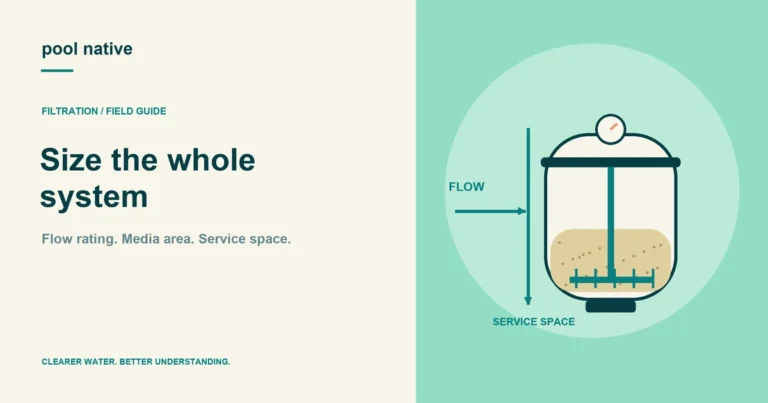
Water volume is a useful input, but it doesn’t tell you the highest flow that will reach the filter. A variable speed pump may run different programs for ordinary circulation, cleaning, and other equipment. Check each relevant mode.
Filter area and maximum flow are different specifications. More area can provide more capacity for collected debris without increasing the allowed maximum flow. Confirm both figures on the exact model’s data sheet.
Use our filter sizing worksheet before comparing units. It includes operating flow, service access, and the equipment limits that a gallons only chart leaves out.
A bigger pump is not a way to rescue a poor match. More flow can exceed a component’s rating. Pump selection and filter selection need to be considered together.
Check the space and the waste route before buying
Measure the footprint and the manufacturer’s service clearance. Include room to stand clear during startup. Leave access to the drain, pressure gauge, air relief, unions, and closure.
Think through how maintenance will happen. Where will removed cartridges go? Can wet sand be taken out without carrying it through the house?
For a backwashing filter, identify an approved discharge route and any local restrictions. A hose pointing into the street isn’t automatically acceptable. Don’t assume a wastewater rule from another country or city applies to your property.
Check fittings and plumbing changes with the installer. Matching nominal pipe size doesn’t guarantee that two filters can be swapped without alteration. Port heights, spacing, valves, and supports may differ.
Compare ownership costs without guessing a lifespan
Ask for an installed quote, not just the tank price. Include any required valve, plumbing changes, approved media, and commissioning. Then look at the maintenance supplies and replacement parts for that exact system.
- Cartridge: the cost and availability of the complete required element set.
- Sand: approved media quantity, disposal arrangements, and access for replacement work.
- DE: approved powder, internal elements, seals, and the expected service process.
- Every type: closure parts, gauge, air relief components, and local service support.
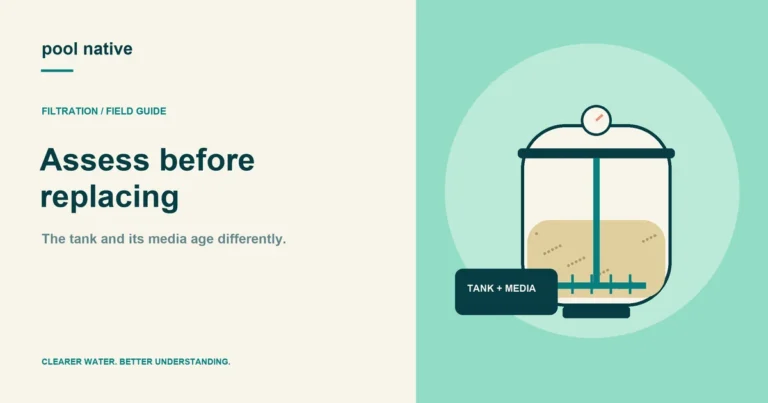
Don’t multiply a promised replacement interval into a precise lifetime cost. Actual condition and operating history affect replacement decisions. Our filter lifespan guide separates consumables from the tank itself.
Recognize when the filter needs attention
Record clean pressure with the pump setting and operating mode. A later pressure change is meaningful only under comparable conditions. Use the manual’s trigger and the guide to filter cleaning frequency.
Cloudy water doesn’t automatically mean failed media. Poor sanitation, a bypass path, inadequate circulation, or a large debris load can also be involved. Replacing a filter without sorting those possibilities can leave the original problem untouched.
If water or debris is behaving strangely, start with filter troubleshooting by symptom. Stop operation for structural damage, a leaking closure, or another unsafe condition. Never open a tank while it is pressurized.
Make the choice in the right order
First, identify the system’s flow and safety requirements. Next, eliminate filters that won’t fit or can’t be serviced at your equipment pad. Then compare the maintenance process and ongoing parts support.
For a small pad with limited overhead room, clearance may settle the decision before media type does. Where backwash discharge is difficult, cartridge filtration deserves a closer look. Where lifting elements is impractical, discuss a service arrangement or another accessible design.
There isn’t one filter type that wins for every home. A well matched system with a routine you can maintain is the useful outcome. Keep the model data and commissioning readings so future maintenance starts from something concrete.