A pool sand filter works by sending water through a bed of specially graded media. The bed captures suspended debris, while internal collectors carry filtered water back toward the pool. The sand stays inside during normal operation.
The useful part to understand is the route. Filtration, backwashing, and rinsing send water through different paths. Once you can picture those paths, the valve labels and common symptoms make much more sense.
How does a pool sand filter work during filtration?
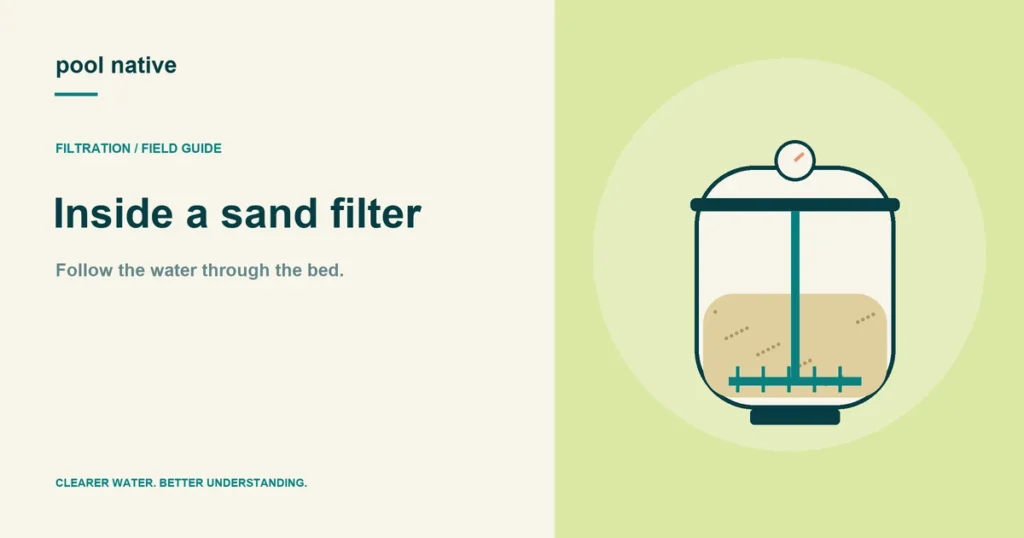
In a typical residential pressure sand filter, water enters above the media bed. A distributor spreads the incoming water. Water travels downward through the bed before reaching the collectors near the bottom.
Those collectors are often called laterals. Their openings allow water through while retaining the specified filter media. Internal piping then carries the filtered water to the outlet.
The external arrangement varies. A top mounted valve commonly connects to a central pipe inside the tank. A side mounted design routes water through different tank connections.
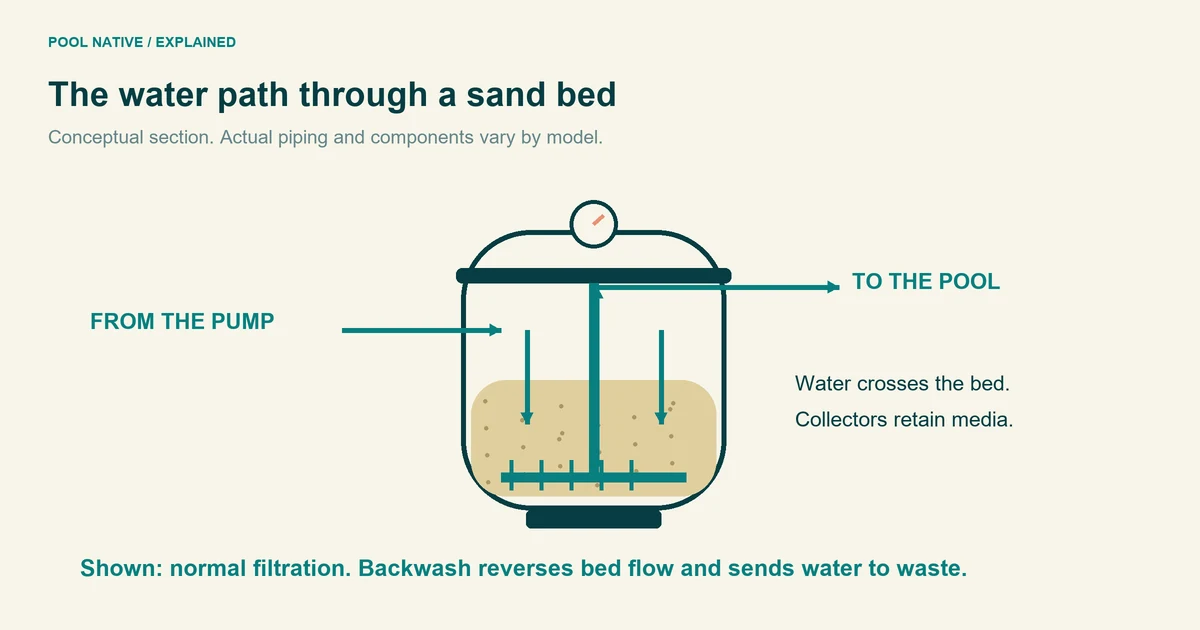
The illustration shows the principle, not a parts diagram for your model. Use the manufacturer’s exploded drawing to identify actual pipes, seals, and air relief components. Similar looking tanks can have different internal assemblies.
Why the sand stays in the tank
Filter media has a specified particle size, and the internal collection system is designed around it. Using the correct grade matters. Ordinary play sand or an unapproved substitute isn’t equivalent merely because it looks similar.
Water passes through spaces in the bed and encounters media surfaces and trapped debris. Filtration isn’t limited to a sheet at the very top. The bed must have the correct depth and room above it for proper operation.
That empty space is called freeboard. It isn’t spare capacity to fill with extra sand. The guide to the correct sand load and freeboard explains why the model’s specification matters.
If actual filter sand continually arrives through the returns, something needs checking. Wrong media, damaged internals, or an operating problem may be involved. Follow the sand return diagnostic route rather than assuming this is normal filtration.
What changes during backwashing
Backwashing sends cleaning water upward through the bed. Collected debris leaves through the waste route instead of returning to the pool. The process needs the flow specified for the equipment.
The purpose is to remove collected contamination, not to empty the tank of sand. Insufficient cleaning flow may leave debris behind. Excessive flow can also cause trouble, so faster isn’t automatically better.
The correct cleaning trigger comes from the manual and comparable operating measurements. Don’t backwash simply to make a pressure gauge read lower after changing pump speed. Our backwashing guide separates the valve arrangements.
How rinse, waste, and recirculate differ
| Common valve setting | Basic purpose | Does water return through the normal filtering route? |
|---|---|---|
| Filter | Capture debris during circulation | Yes, through the media and back to the pool |
| Backwash | Clean the bed with reversed flow | No, cleaning water goes to waste |
| Rinse | Settle the bed and carry remaining dirty water to waste | No, discharge remains on the waste route |
| Waste | Discharge water while bypassing normal filtration | No |
| Recirculate | Return water while bypassing the media | No filtering through the bed |
| Closed | Close the valve path | Never a pump running position |
Not every valve has all these settings. A two position slide valve doesn’t gain a rinse setting because a generic guide includes one. Always stop the pump before changing the control valve position and follow the model’s procedure.
Why pressure changes as debris collects
A loading filter can add resistance to water flow. Under comparable operating conditions, the gauge may rise while return flow declines. That pattern helps identify a cleaning need.
The gauge still isn’t a direct measurement of dirt or flow. Pump speed, valve mode, downstream restrictions, and gauge condition affect what you see. Record the clean reference with the settings attached.
Use the pressure comparison method instead of treating a generic psi number as universal. Never exceed equipment limits while waiting for a cleaning threshold.
What a sand filter cannot fix
Filtering doesn’t replace sanitation or water balance. It also doesn’t identify the cause of cloudiness. A functioning filter can be collecting debris while a separate water problem continues.
Nor does fresh sand repair a damaged valve or lateral. If performance changes, look at the symptom and the recent service history before buying media. Replacement timing is a different decision from routine backwashing.
Keep the basic route in mind: through the bed to the pool during filtration, through a cleaning path to waste during backwashing. That distinction helps you describe a problem accurately and choose the next check.