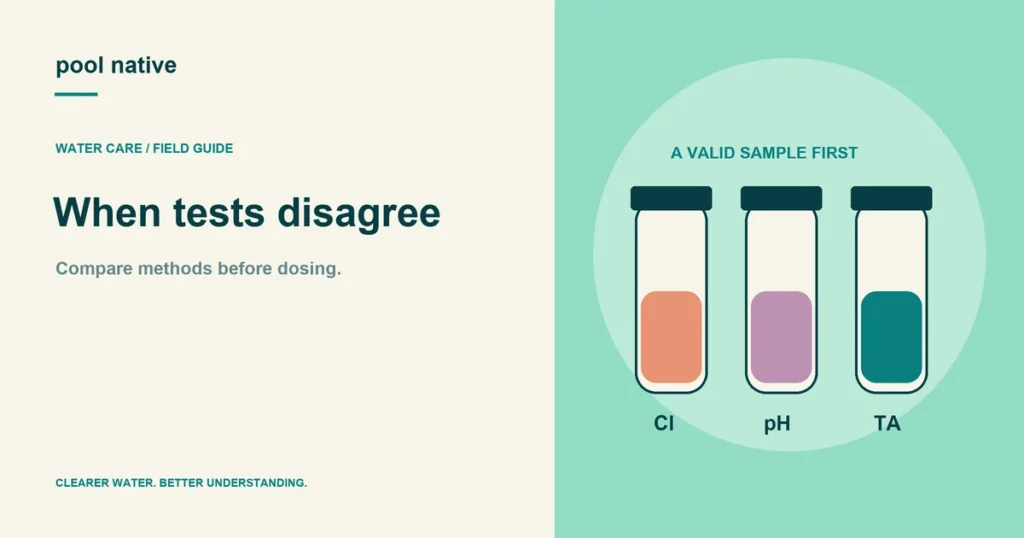
When pool test strips and a liquid kit disagree, don’t average the readings or immediately add chemicals. First check whether they measured the same thing from comparable samples. Free chlorine and total chlorine, for example, can legitimately be different.
Take a fresh sample and work through the procedure before deciding which result to trust. A liquid kit can be misused or contain degraded reagents. A strip can be misread, mistimed, or outside its useful range.
Compare like with like
Write down the exact measurement, units, test range, and time. Check whether one product reports total hardness while another measures calcium hardness. Confirm that a store report’s stabilizer entry means cyanuric acid rather than assuming from a vague label.
Samples taken before and after dosing aren’t a fair comparison. Neither are samples taken at different places while a product is mixing. Repeat the comparison from representative water at the same time.
Check each method’s likely weak point
| Method | Check first |
|---|---|
| Strips | Expiry, dry storage, dip procedure, reading time, and matching bottle chart |
| Liquid comparator | Sample volume, correct reagent, drop count, and lighting |
| Titration | Endpoint, sample factor, drop formation, and reagent sequence |
| Digital test | Correct blank, clean vial, reagent preparation, and instrument range |
Keep the strip beside its own chart in the instructed orientation. Don’t read it after the specified window has passed. For liquid tests, don’t substitute a visually similar bottle from another kit.
Look for an interference, not just an error
High chlorine can distort some chlorine and pH tests. Certain oxidizers can interfere with combined chlorine testing. A water sample with its own strong color or turbidity can also complicate methods that depend on light transmission.
Check the exact manufacturer’s interference notes. Use the purple pH route or chlorine bleaching checks when those patterns fit. Repeating the same affected procedure may repeat the same wrong answer.
Use an independent check when the difference matters
Choose a method suitable for the expected range or ask a competent pool professional to test a fresh sample. Tell them what was added and when. A printout without the method or sampling context doesn’t automatically settle the disagreement.
For CYA, compare a strip result cautiously with the broad visual increments of a turbidity test. Neither result should be presented with precision its method cannot support. Record below range and above range results honestly.
If sanitation is uncertain, keep swimming on hold until you have a valid reading and meet the applicable conditions. Don’t resolve a disputed low result by adding a large blind dose. Confirm the measurement, then follow the normal water testing and treatment sequence.