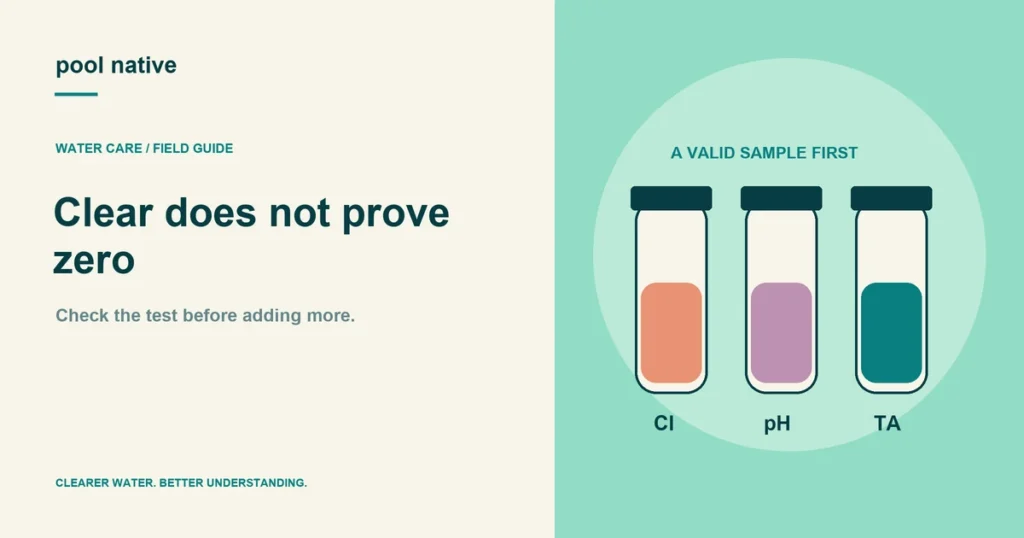
A clear chlorine test after a recent addition can mean chlorine is low, but it can also mean the test has bleached or failed. Don’t keep adding chlorine until you know which explanation fits. A misleading zero can turn a testing problem into an excessive dose.
This warning is especially relevant to DPD methods at high chlorine. CDC notes that concentrations above 10 ppm can partially or completely bleach some tests. The exact response and corrective method depend on the kit.
Reconstruct the last addition
Write down the product, strength, quantity, pool volume, and elapsed circulation time. Confirm that the addition reached the pool rather than an isolated feeder or empty line. Check whether the result came from representative water after the label’s mixing period.
Also identify the test. A strip, color comparator, and FAS-DPD kit may have different ranges and interference procedures. The words chlorine test are not enough to choose a remedy.
Check for a testing explanation first
Use a new sample with the correct volume and fresh compatible reagents. Observe whether color appears briefly and then disappears. That pattern can be a clue, but it is not a calibrated measurement of how high chlorine is.
Follow the manufacturer’s method for suspected high chlorine. This may involve an approved dilution, a specified reagent adjustment, or a different suitable test. Don’t invent a dilution ratio or multiply an altered pH test in the same way.
For a FAS-DPD kit, use its powder, mixing, titration, and endpoint instructions exactly. Don’t add arbitrary quantities of reagent because another kit’s instructions recommend it. The method comparison explains why procedures differ.
If a reliable test confirms low chlorine
Then investigate actual demand and delivery. Organic contamination, sunlight, an inadequate addition, inaccurate pool volume, or weakened stored product can all contribute. A salt system or feeder may also be failing to deliver what its setting suggests.
Review the liquid chlorine storage guide when old product is involved. Record successive readings after properly measured treatment, using the product’s instructions. Don’t diagnose an exotic water problem before checking the ordinary inputs.
Keep the response controlled
| Finding | Response |
|---|---|
| Result above the method’s range | Use an appropriate verified measurement procedure |
| Expired or mishandled reagent | Replace or verify the reagent before dosing |
| Valid low residual after mixing | Correct according to the sanitizer label and investigate demand |
| High residual confirmed | Stop additions and use the high chlorine correction route |
Keep swimmers out while the sanitizer condition is uncertain. Once you establish the real reading, use chlorine interpretation or high chlorine correction as appropriate. A clear sample is a starting observation, not an instruction to pour.