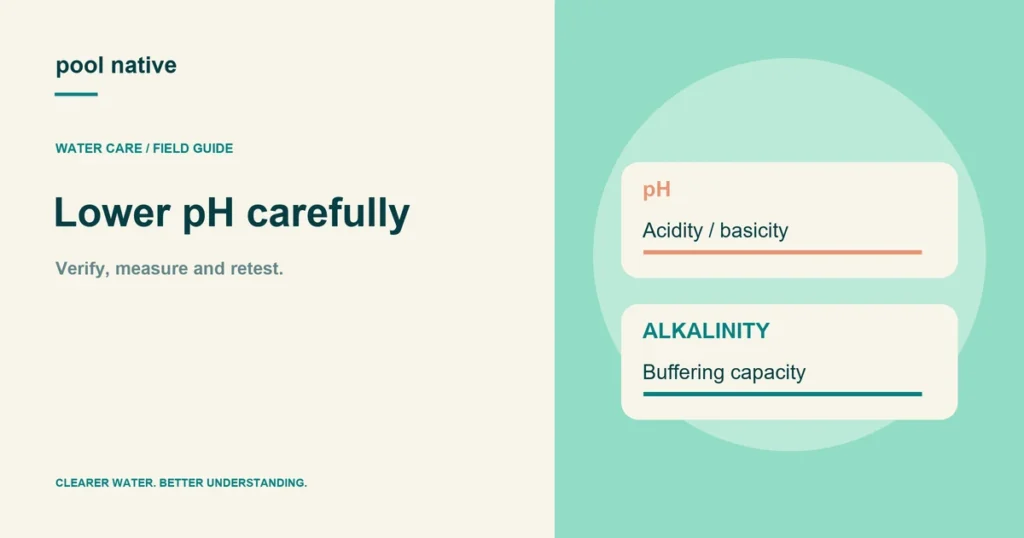
To lower pool pH, confirm the reading, measure alkalinity, and use a pool acid product according to its label. The amount depends on pool volume, starting chemistry, target, and product strength. A high pH reading alone cannot tell you how many cups to pour.
Keep swimmers out while conditions are unsuitable and during treatment as directed. Wear the protection required by the label. Acid and chlorine concentrates must never be mixed or added together.
Make sure the high reading is real
Repeat a questionable test from a representative sample. Check whether high chlorine has pushed the pH indicator outside its valid operating conditions. Use the purple pH test guide if the color doesn’t match the scale normally.
Measure total alkalinity too. Water with greater buffering can require more acid for the same pH movement. Don’t borrow a dose from another pool just because it has the same gallons.
Choose a compatible acid product
Common pool pH reducers include muriatic acid and sodium bisulfate products. Their strengths, handling, and suitability differ. Check finish and equipment restrictions, including guidance about cumulative sulfate exposure where relevant.
Use the actual label concentration and dosing instructions. Reduced strength muriatic acid is not interchangeable by volume with a stronger formulation. Dry acid is not measured using a liquid acid chart.
Determine the amount before opening the container
Use the manufacturer’s dose guidance, a suitable acid demand test, or a calculation that accounts for the relevant chemistry. Choose a target within the applicable operating requirements. Do not aim below the normal range merely to postpone the next adjustment.
If a label gives a reference dose, scale it only for the conditions that reference actually covers. Keep weight and volume units separate. Measure with dedicated compatible equipment rather than kitchen utensils.
Add and circulate exactly as directed
Follow the label for pump operation, location of addition, dilution, and separation from other chemicals. If dilution is required, follow the stated order and use appropriate equipment. Never pour water into concentrated acid.
Don’t add acid through the skimmer unless the exact system instructions explicitly require an approved procedure. Don’t pour a concentrated stream onto a finish or leave it pooled on the bottom. Keep clear of vapors and stop if you cannot handle the product safely.
Retest pH and alkalinity
After the specified circulation period, take another representative sample. Check both pH and alkalinity because acid affects both. Use staged correction where the product instructions permit rather than adding a second full dose blindly.
If pH rebounds repeatedly, investigate the pH and alkalinity relationship. Aeration, elevated alkalinity, fill water, and normal system chemistry can affect the trend. The answer may be a different operating plan rather than more frequent large doses.
If alkalinity is also too high, use the coordinated alkalinity reduction route. Record the correction in the maintenance log. Resume use only when the label’s reentry conditions and the required water readings are satisfied.