THE POOL NATIVE LIBRARY

Cleaners.

Compare cleaning systems and solve everyday snags.

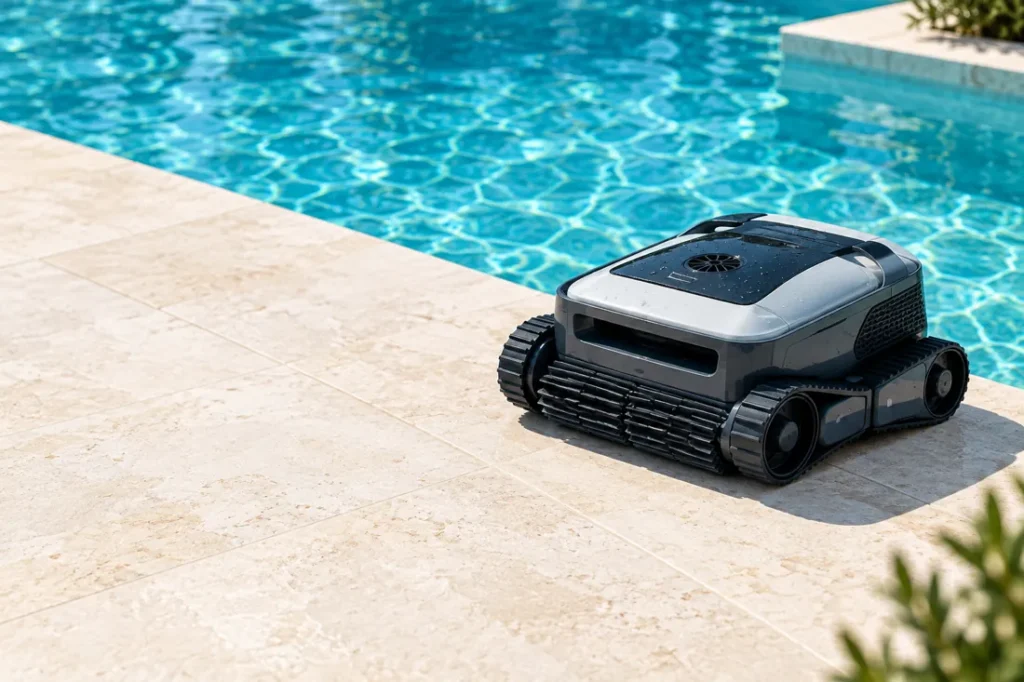
Illustrative robotic pool cleaner on a poolside deck

From the library

51 guides to explore

Choose for the leaf load. Intake clearance; Collection capacity; Surface compatibility. Conceptual illustration.

Choosing a Pool Cleaner for Heavy Leaves

A pool full of leaves needs room in both the cleaner’s intake and its collection bag. A powerful motor cannot pull an oversized leaf through a narrow opening. For a heavy load, start by removing the bulk with a leaf rake, then choose a cleaner for what remains.
Read the guide →
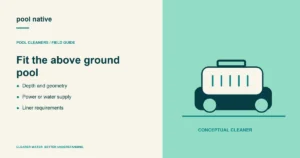
Fit the above ground pool. Depth and geometry; Power or water supply; Liner requirements. Conceptual illustration.

Choosing a Cleaner for an Above Ground Pool

Start with the shape and water depth of your above ground pool, then check its pump and connections. A cleaner that fits the pool’s length can still struggle with a soft liner, a steep floor transition, or shallow water. The above ground label alone does not prove compatibility.

Read the guide →
Connect a manual vacuum. Fill the hose with water; Use the approved fitting; Watch prime and returns. Conceptual illustration.

How to Vacuum a Pool with a Manual Vacuum

To connect a manual pool vacuum, attach a suitable head and hose, fill the hose completely with water, and connect it to the pool’s approved vacuum point. Keep the pump off while making the connection. An air filled hose can make the pump lose prime before cleaning begins.

Read the guide →
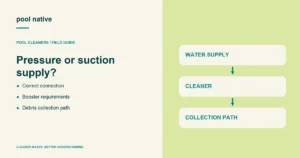
Pressure or suction supply?. Correct connection; Booster requirements; Debris collection path. Conceptual illustration.

Pressure Side vs Suction Side Pool Cleaners

Pressure and suction pool cleaners both use moving pool water, but they connect to opposite sides of the circulation system. A suction cleaner draws water toward the pump. A pressure cleaner receives water from a return supply and usually collects larger debris in its own bag.

Read the guide →
Pickup is only half the job. Reach the sediment; Retain the particles; Clean the right media. Conceptual illustration.

Choosing a Pool Cleaner for Fine Sand and Silt

A cleaner can lift fine sand from the floor and still leave the pool looking dusty. The missing step is retention: the filter must hold the particles after the intake collects them. Choose a cleaner by its compatible fine debris media, not by a claim of powerful suction alone.

Read the guide →
Choose the cleaning job. Debris and surface; Available connections; Ongoing care.

Pool Cleaner Guide: Choose by Debris and Equipment

The right pool cleaner depends on what you need removed, where it collects, and which connections your pool provides. A robot can collect debris independently of the pool filter. Suction and pressure cleaners use the pool’s circulation equipment, while manual tools let you target a specific mess.

Read the guide →
Set up by cleaner type. Robot: own filter; Suction: regulated flow; Pressure: supply match.

How to Use a Pool Cleaner: Setup by Type

How to use a pool cleaner depends on whether it runs from electricity, suction, or return pressure. Identify the type and exact model before connecting it. Then prepare the pool, follow its setup procedure, and watch a full cycle before changing settings.

Read the guide →

LESS GUESSWORK. MORE POOL TIME.

Let’s do the numbers.