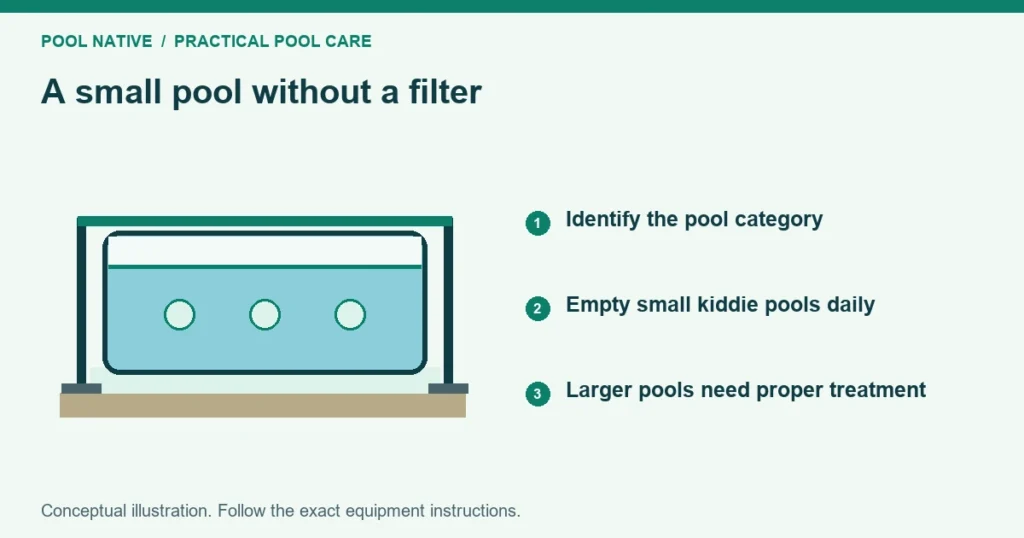
A small pool without a filter can be suitable for a daily drain and clean routine if it is a small kiddie pool. A larger pool intended for ongoing water use needs its specified filtration and disinfection. Adding chemicals does not erase that distinction.
Check the pool’s instructions before deciding to keep water between uses. “Small” has no universal gallon threshold that safely answers this question. Intended operation matters more than a retailer’s informal description.
Identify why there is no filter
| Situation | What to do |
|---|---|
| Small kiddie pool designed for simple filling and emptying | Use the daily drain, rinse and dry routine |
| Larger pool sold without a pump | Check what equipment the manufacturer requires before use |
| Filter was removed to simplify maintenance | Restore the required system |
| Pump or filter has failed | Stop use while diagnosing and repairing the system |
| Product instructions are missing or unclear | Obtain the model instructions before choosing a treatment routine |
A pool being sold without equipment does not prove it is designed to operate indefinitely without equipment. Some packages expect the owner to supply compatible components. Check the exact model and connections.
Why CDC treats kiddie pools differently
CDC advises against adding chlorine or bromine to small inflatable or plastic kiddie pools. Splashing and spilling can quickly change the water volume. These pools also lack filters that remove material which can consume disinfectant.
For that category, empty the water at least daily. Remove debris, rinse away dirt and let the pool air dry. Keep it from collecting accessible rainwater after use.
Larger inflatable or plastic pools need filtration and disinfection according to the manufacturer. A ring that inflates does not make a large pool a kiddie pool. Use the portable pool care guide to establish the appropriate routine.
What a net, cover and vacuum can actually do
A net helps remove leaves and insects. A suitable vacuum can remove some settled debris. Neither establishes a disinfectant residual or removes every contaminant.
A cover can reduce incoming debris when correctly used. It does not disinfect retained water. A floating blanket or basic debris cover is also not a safety barrier.
Do not treat sparkling water as evidence that an unfiltered arrangement is working. Some contamination is not visible. Smell and appearance cannot replace the required care system.
Can you just change some water?
For a small kiddie pool, use the complete daily emptying and cleaning route. Topping up yesterday’s water does not perform that cleaning. Skimming before adding fresh water leaves material on the surfaces.
For a larger pool, partial water replacement does not replace its required filtration and treatment. The correct response to missing equipment is to establish the specified system. Do not invent a recurring water change percentage to justify continued swimming.
Plan a suitable discharge location before choosing a pool that must be emptied frequently. The route must be lawful and avoid property damage. If that routine is impractical, choose a pool arrangement you can maintain properly.
Should you add a pump to a kiddie pool?
Do not assume any small pump converts the pool into a suitable circulating system. Safe suction arrangements, compatible fittings, flow and electrical protection matter. A loose hose dropped over the wall is not a verified installation.
Ask the pool manufacturer whether an approved filtration arrangement exists. If none exists, follow its intended care method. Buying a purpose designed filtered pool may be more practical than modifying an unsuitable one.
For a pool that already supports compatible equipment, follow its connection instructions. Use the hose and fitting identification guide where relevant. A filter’s advertised flow alone does not establish compatibility.
What if the usual filter has broken?
Keep swimmers out while restoring the required system. Follow the equipment troubleshooting instructions and maintain water treatment as directed. There is no fixed number of filterless days that makes every pool acceptable for use.
Once repaired, verify flow, water clarity and the applicable test results. Use proper water testing rather than guessing from the amount of chlorine added. Follow product labels before returning to swimming.
Contamination and supervision still matter
Keep anyone with diarrhea or vomiting out of the water. If poop or vomit enters a kiddie pool, remove swimmers and follow CDC’s cleaning and surface disinfection procedure. Do not try to salvage the swimming water with an improvised chemical dose.
Closely supervise children and secure access whenever water is present. Small depth does not remove drowning risk. Follow home pool safety requirements and the rules for your location.
The workable choice is a routine you can carry out consistently. Use daily draining and cleaning for the appropriate small pool, or the required treatment system for a larger one. If the product’s category remains unclear, get that answer before filling it again.