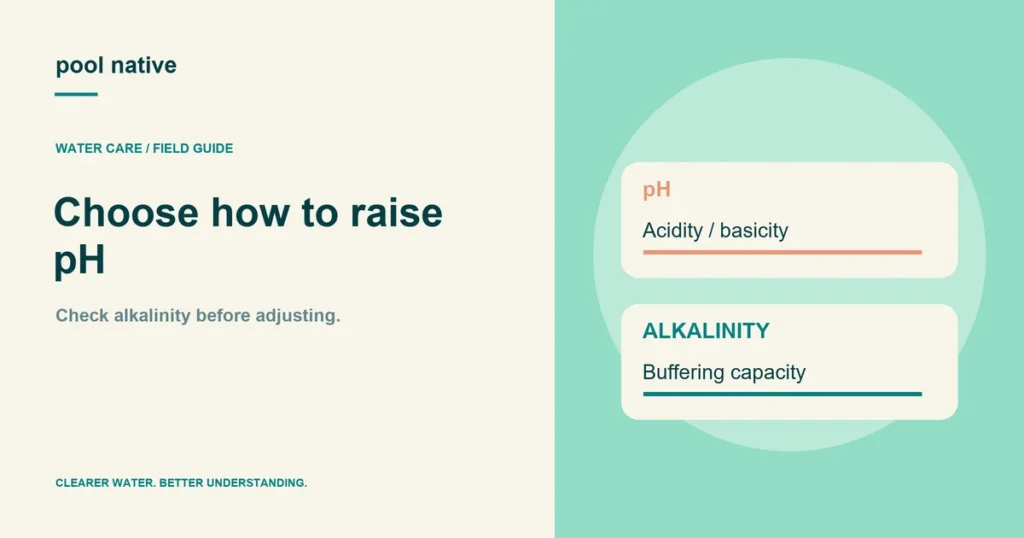
To raise pool pH, first confirm that the reading is genuinely low and check total alkalinity. A suitable pH increaser can raise it, but controlled aeration may fit when alkalinity is already adequate or high. The right choice depends on what else needs to change.
Do not add soda ash solely because a strip looks unusual. Check the test, recent acid additions, and mixing time. A correction based on the wrong reading can overshoot and make the pool cloudy.
Find the reason pH is low
Review recent acid dosing, acidic sanitizer use, and refill water. Confirm that an automatic acid feeder has not overfed. If an equipment fault is continuing to add acid, correct that source before treating the water repeatedly.
Test alkalinity from the same representative water. Low buffering and low pH need a different plan from low pH with ample alkalinity. Use the combined reading guide to choose the route.
Decide between a chemical addition and aeration
Sodium carbonate, often called soda ash, raises pH and alkalinity. It can be useful when a chemical increase is justified, but too much can push both readings higher than intended. Local high pH can also encourage calcium precipitation and cloudiness.
Aeration can raise pH by encouraging carbon dioxide loss without acting as an alkalinity increaser. It may suit a controlled correction when alkalinity is already sufficient. The rate depends on water chemistry and aeration, so monitor rather than promising a fixed number of hours.
Sodium bicarbonate is generally selected for alkalinity correction. It is not an interchangeable pH dose for soda ash. The two compound comparison explains why their effects differ.
Apply a measured correction
Select an appropriate pool product and follow its label for dose, addition, circulation, and reentry. Use actual water volume and a target suited to the finish and equipment. Don’t pour in an entire bag because the initial reading is below the scale.
Keep products and measuring tools separate. Follow any specified dilution instructions rather than assuming every powder should be dissolved in advance. Avoid concentrated contact with the pool surface.
Retest after the required circulation period before adding more. Measure alkalinity as well as pH when using a chemical that changes both. Record the result instead of treating the first predicted dose as a guaranteed outcome.
Watch for overshoot and recurrence
If the water turns milky after an addition, stop stacking chemicals and investigate cloudy water causes. Calcium precipitation can be part of the problem. A clarifier does not reverse an inappropriate chemical dose.
If low pH keeps returning, review the source of acidity and the system’s buffering. Correct low alkalinity when the evidence supports it. Don’t alternate acid and soda ash simply to chase a color block.
Keep swimming on hold until required pH, sanitizer, clarity, and product conditions are satisfied. Save the starting readings and response in the maintenance log. That makes the next adjustment more predictable.