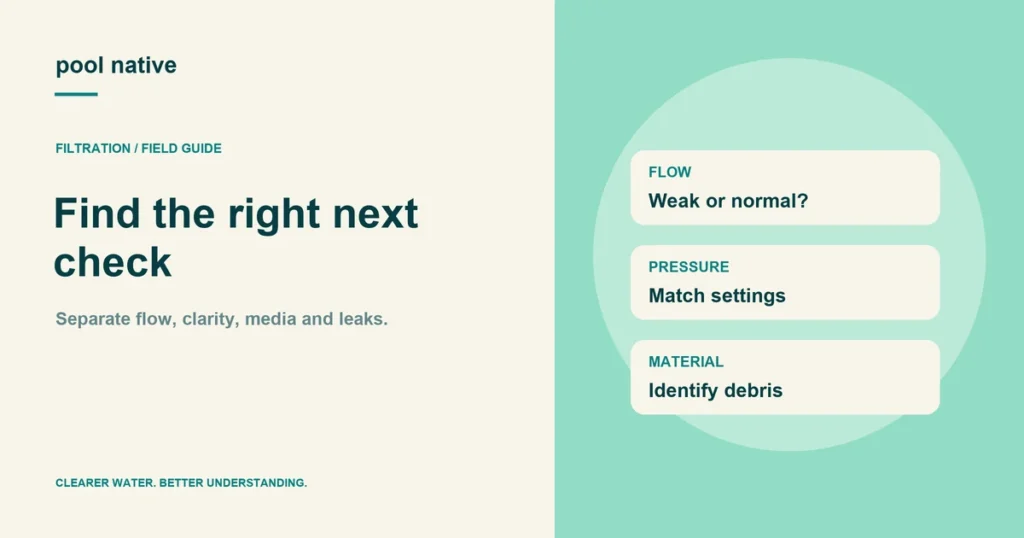
If your pool filter isn’t working, start by separating weak water flow, poor water clarity, escaping media, and leakage. Those symptoms don’t all point to a dirty filter. The pump, valve path, water chemistry, and internal seals can produce similar complaints.
Record what changed before touching the equipment. Then use the matching route below. Don’t replace media or keep backwashing until you’ve established what the system is actually doing.
Pool filter not working: first decide whether to stop
Stop operation for a leaking closure, cracked or distorted tank, unsafe electrical condition, or another obvious equipment hazard. Follow the shutdown instructions and arrange qualified service. Never tighten or open a pressurized filter.
Keep swimmers out if the bottom isn’t clearly visible or a suction cover is damaged. Don’t test suction with your hand. The filter diagnosis can wait while an unsafe pool remains closed.
If the system won’t release pressure through its specified procedure, stop the service attempt. A gauge at zero is not enough when its operation is uncertain. Don’t loosen a fitting to find out.
Choose the symptom that matches what you can observe
| Observed problem | First distinction | Next route |
|---|---|---|
| Weak returns with low pressure | Is water reaching the pump normally? | Check visible water supply, baskets, prime, and operating settings |
| Weak returns with high pressure | Is this high compared with the same settings? | Check filter loading and downstream restrictions |
| Cloudy water with apparently normal operation | Is sanitation adequate, and is water actually passing through intact media? | Check water results, valve mode, and internal bypass possibilities |
| Sand or DE entering the pool | Is the material identified, and did service precede it? | Investigate the appropriate media retention path |
| Leakage from the equipment | Is it a closure, tank, fitting, or waste port? | Shut down unsafe leakage and identify the exact source |
The table routes your next check. It doesn’t diagnose a component from one gauge reading. Several faults can occur together.
Low pressure and weak flow
Check the pool water level against the skimmer’s requirements. Look for obvious debris loading in accessible baskets using the correct shutdown procedure. Note whether the pump is primed and whether air is visible where it normally isn’t.
Confirm the intended pump program is active. A temporary low setting, stopped schedule, or startup fault can look like filter failure. The pump system guide explains the distinction between moving water and filtering it.
If the visible checks don’t explain the problem, pump or suction line diagnosis may be needed. Don’t open the motor or reach into an impeller. A qualified technician can check the supply path and actual flow.
High pressure, especially after cleaning
Match pump setting and operating mode with the clean reference. A reading during spa mode or a faster cleaning cycle may not be comparable. A faulty gauge can also confuse the picture.
If the comparison is valid, distinguish gradual loading from pressure that was high immediately after service. A dirty element is only one possible restriction. The return side of the system matters too.
Use the high pressure diagnostic guide for the detailed sequence. Don’t run beyond equipment limits while trying to establish a pattern.
Cloudy water with no obvious pressure problem
Check actual water test results and recent events. A filter doesn’t replace sanitizer. Cloudiness can continue even while the filter is collecting debris correctly.
Confirm the valve is in the proper filtering mode where a bypass setting exists. Recirculate can move water back to the pool without sending it through the filter bed. Return flow alone doesn’t prove filtration.
Internal bypass is another possibility. Torn fabric, an incorrectly seated element, or a damaged seal can let debris avoid the intended route. Inspection requires the exact service procedure, not an improvised look inside a running tank.
Use the filter system overview to identify your design. Investigate water conditions and mechanical filtration together rather than treating one as proof that the other is fine.
Media or debris comes through the returns
Identify the material and note when it appears. Sand after a refill suggests a different investigation from DE after a grid service. Ordinary dirt passing through a cartridge system can involve damaged or incorrectly fitted elements.
For granular media, use the sand discharge checks. For a cartridge system, verify the elements against the correct replacement identification process. Don’t assume the previous installed part was right.
Persistent media return after correct startup deserves service. Repeated vacuuming treats the deposit while leaving its source untouched. Save photographs and the media or part information.
Leakage: describe the location precisely
Water under the equipment can come from several points. Observe without touching energized equipment or standing over a suspect closure. Stop the system if the leak involves the tank or closure.
A waste line leaking during Filter mode can suggest a valve routing or seal problem. It doesn’t establish that the sand needs replacement. Record the valve position and when the discharge occurs.
For a fitting or seal repair, use the exact parts and installation instructions. Never plug a relief device or glue a structural crack. Pressure equipment needs an approved repair or replacement.
Bring a useful problem record to the next step
Save the model labels, symptom timing, recent work, and water results. Include pump settings with each pressure reading. Our maintenance record template keeps those facts together.
Change one relevant condition at a time when the manual allows it, and record the result. Don’t combine new media, valve changes, and chemical treatments without a diagnosis. You’ll lose the ability to tell what helped.