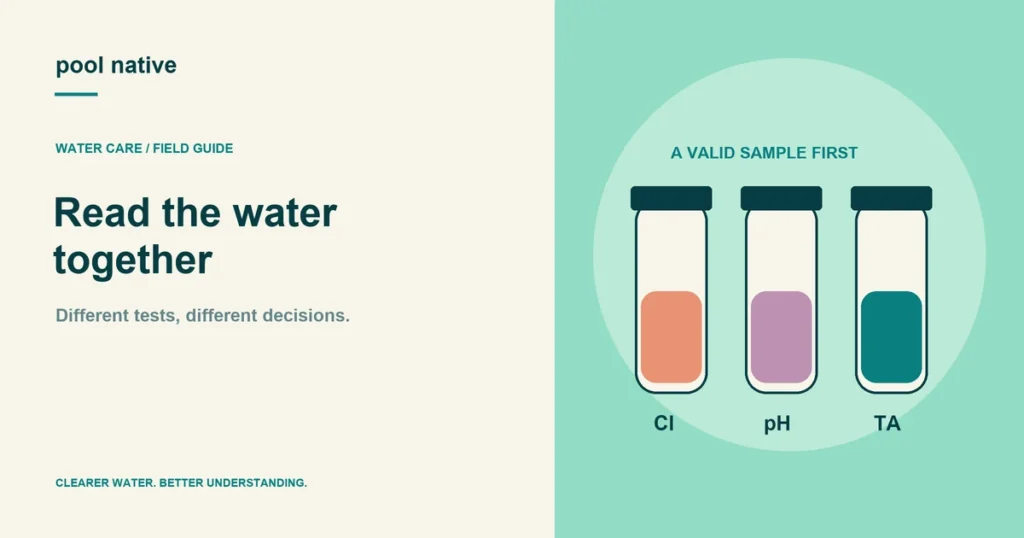
Pool water chemistry becomes easier when each result has a job. Free chlorine tells you about available sanitizer, pH describes acidity, and alkalinity helps explain resistance to pH change. Calcium hardness, cyanuric acid, temperature, and salt add context that a single color strip cannot summarize.
The goal is not to push every reading to the middle of a generic chart. Choose operating targets that suit the sanitizer, surface, equipment, product labels, and applicable guidance. Then make measured corrections and verify the result.
Read the important measurements together
| Measurement | What it helps you decide | Common mistake |
|---|---|---|
| Free chlorine | Whether the available sanitizer meets the operating requirement | Using total chlorine as an equivalent reading |
| pH | Whether acidity needs correction | Trusting an abnormal color during very high chlorine |
| Total alkalinity | Buffering and the likely response to acid | Treating it as another name for pH |
| Calcium hardness | Compatibility with finish and calcium balance | Using total hardness as an identical measurement |
| Cyanuric acid | Stabilizer context for chlorine management | Adding stabilized chlorine indefinitely without retesting |
| Salt | Suitability for a salt chlorine generator | Assuming salt itself replaces chlorine testing |
Record temperature too when assessing calcium balance. A saturation index uses several inputs and answers a calcium carbonate balance question. It is not a sanitation score and cannot confirm that a pool is safe to enter.
Start with a trustworthy sample
Use a suitable kit, fresh compatible reagents, and the manufacturer’s sampling and reading instructions. Test away from a return jet or a recent chemical addition. Read results promptly rather than leaving a sample while you do another job.
CDC advises residential owners to test chlorine and pH at least twice daily, and more often with heavy use. Broader tests follow the treatment system’s needs and events such as a refill. The testing methods guide helps you choose a workable routine.
If two methods disagree, investigate before averaging them. Different ranges, timing, reagent condition, and interferences can explain the difference. Use the disagreement checks rather than voting for the result you prefer.
Understand chlorine before choosing a treatment
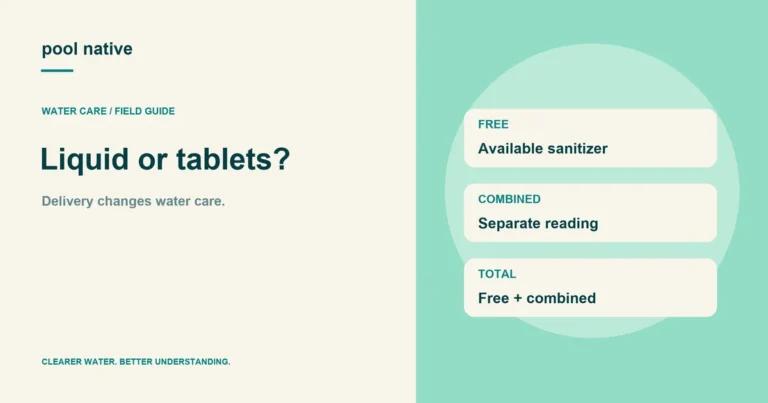
Free, combined, and total chlorine describe different measurements. The chlorine readings guide explains how to use them. A strong odor or clear water cannot replace a valid sanitizer result.
Cyanuric acid changes the context for chlorine management. CDC’s residential guidance sets a higher minimum when stabilizer is present, but a public health minimum is not a complete treatment program. Follow the requirements for the actual system and product.
Know what the sanitizer adds besides chlorine. Trichlor and dichlor add stabilizer; calcium hypochlorite adds calcium; liquid sodium hypochlorite doesn’t add either of those. The liquid chlorine and tablet comparison explains why the long term effects matter.
Separate pH correction from alkalinity correction
pH and alkalinity interact, but they are not interchangeable. Adding acid lowers both. Aeration can raise pH by encouraging carbon dioxide loss without serving as an alkalinity increaser.
Sodium bicarbonate is normally chosen to increase alkalinity, while sodium carbonate has a stronger pH raising effect. Neither should be added simply because the water looks cloudy. Use the pH and alkalinity decision guide before selecting a product.
Choose a correction target, calculate from real water volume and product strength, and follow the label’s application instructions. Allow the specified circulation and retest. Don’t stack several guessed corrections before seeing what the first one did.
Keep a treatment sequence you can explain
Record the reading, chosen target, product, strength, quantity, time, and follow up result. Keep additions separate from test entries. A later reader should be able to tell which reading came before which treatment.
If the pool was just filled, use the fresh fill startup route. New plaster requires its finish provider’s commissioning process and should not be treated as an ordinary refill. Seasonal opening also includes equipment checks beyond water chemistry.
Never mix pool chemicals together or reuse a contaminated scoop between products. Store them as their labels require. Keep acid away from chlorine products and follow the applicable safety equipment and application directions.
Respond to problems instead of collecting bottles
Cloudiness can involve sanitation, suspended debris, calcium precipitation, or impaired filtration. Green water may involve algae or metals. Foam can follow contamination or a chemical addition.
Use cloudy water diagnosis, algae identification, or foam troubleshooting to narrow the problem. Adding shock, clarifier, algaecide, and acid together can obscure the cause and create a new one.
Keep swimmers out when sanitation is unconfirmed, the bottom is not clearly visible, or a product’s reentry conditions are unmet. A clock, a smell, and a photograph are not substitutes for the required measurements. Return to a stable routine only after the actual problem has been resolved.